Some of the key characters in the epic were born through an ancient custom called the Niyoga. A custom that traces its origins to a Rig Vedic ritual and a myth around Parashurama.
Click to know more about the Whats, the Whys and the Hows of the custom!
King Yayati wanted to enjoy the pleasures of life for long and demanded that his sons trade their youth for his old age. Puru, his youngest son, satisfied his father’s lust for life by sacrificing his youth.
King Shantanu fell in love with a fisherwoman at an advanced stage of his life. His son, Devavrata, ensured that his father’s desire was satisfied even though it meant he would have to sacrifice his kingship and sex life forever!
Why do we find dominating fathers and submissive sons in Indian stories?
In the Mahabharata, the entire premise of the horrific Kurukshetra war was that the Pandavas had a legitimate claim to a part (if not the whole) of Hastinapur, which they were being denied.
But did the Pandavas led by Yudhishtra have a truly credible claim to the throne?
Surprisingly, one look at the history of the Kuru clan tells us that primo geniture, which is the right to succession that comes from being the first-born, was never the norm among the Kurus.
Listen in to hear the stories of Yayati and King Bharata that tell you how, in the Kuru clan, issues of succession were decided by factors other than primo geniture!
Everyone knows that the Mahabharata is an epic! The longest poem of the world! A great piece of world literature!
But how many of us actually know about the nature of the epic?
Apart from the core narrative of the rift in the Kuru family, the epic has several layers of content containing long discourses on politics and statecraft, several teachings for the common man to help him lead his everyday life, detailed descriptions on various religious doctrines and last but not the least, the crest jewel of Indian philosophy, the Bhagawad Gita.,,,,
Phew! That was a long list….Oh! Wait! Don’t forget the 67 sub-tales called Upakhyanas and hundreds of small and big fables, parables, folklore, myths and legends!
Because of its vast size and extreme complexity of its contents, the epic has even been described as a monstrous chaos!
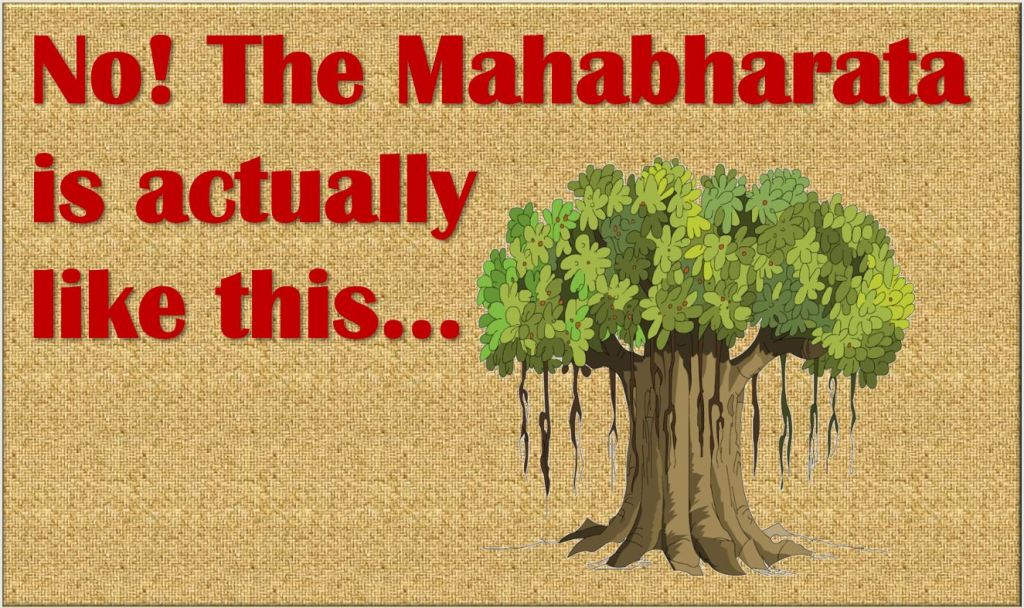
So, is the Mahabharata something like this?
No! Say those who have studied the epic in-depth and seen its underlying patterns. They say, the Mahabharata is like the banyan tree….
Why is Krishna blue, is a question that we have all asked sometime in our childhood. It turns out that Krishna was not always blue.
Krishna, Indologists believe, may have been a pastoral deity, which explains why he is depicted with cows, donning peacock feathers and playing the flute, an instrument of the forest.
Krishna is also among the oldest deities known to us. So, his form and iconography have changed significantly over the centuries, when his skin colour changed from black to indigo to blue,
Check the journey of Krishna over the centuries and find out how he turned blue by playing the video!


 Kulture Katha