The Mahabharata is the largest treasure house of stories in the world, particularly of miraculous or super-natural births.Drona is born in a cup.
Two women come together to produce a child and a King gives birth to his son from his right thigh. These are only some of the several amazing stories in the epic.
But what was the idea behind telling these stories?
Were they merely fantasies of a fertile mind or was there was some meaning to these fantastic tales?
As always, Kulture Katha gets behind the why of the stories!
Some of the key characters in the epic were born through an ancient custom called the Niyoga. A custom that traces its origins to a Rig Vedic ritual and a myth around Parashurama.
Click to know more about the Whats, the Whys and the Hows of the custom!
King Yayati wanted to enjoy the pleasures of life for long and demanded that his sons trade their youth for his old age. Puru, his youngest son, satisfied his father’s lust for life by sacrificing his youth.
King Shantanu fell in love with a fisherwoman at an advanced stage of his life. His son, Devavrata, ensured that his father’s desire was satisfied even though it meant he would have to sacrifice his kingship and sex life forever!
Why do we find dominating fathers and submissive sons in Indian stories?
In the Mahabharata, the entire premise of the horrific Kurukshetra war was that the Pandavas had a legitimate claim to a part (if not the whole) of Hastinapur, which they were being denied.
But did the Pandavas led by Yudhishtra have a truly credible claim to the throne?
Surprisingly, one look at the history of the Kuru clan tells us that primo geniture, which is the right to succession that comes from being the first-born, was never the norm among the Kurus.
Listen in to hear the stories of Yayati and King Bharata that tell you how, in the Kuru clan, issues of succession were decided by factors other than primo geniture!
The Mahabharata is narrated for the first time at a horrific snake sacrifice conducted by Arjuna’s great grandson and Abhimanyu’s grandson, Janamejaya.
But how does the snake sacrifice relate to the core story of the epic? How does the Sarpa Sattra or the snake sacrifice set the perfect context for the epic?
There are many stories and events in the Mahabharata that appear to contradict each other.
Some stories urge us to embrace life, while some other suggest we give it up. Some stories recommend rituals while some others point to their futility.
Why does the epic present such contradictory ideas ? And how do we understand them?
Listen in to know the how and the why and also find the secret thread that binds these varied ideas together to make the epic work like a single, unified text!
Damsels in distress and knights rushing to rescue them from the clutches of wily witches, scheming step-mothers and dangerous dragons has been the common theme of most fairy tales from our childhood. These stories from medieval Europe have largely presented women as delicate, helpless beings, incapable of defending themselves, and waiting for a valiant prince to arrive and liberate them from their miserable existence.
Surprisingly for a patriarchal society, this theme of men rescuing women is quite rare in Indian mythology, other than, of course, the famous story of Rama who goes out in search of his kidnapped wife.
On the contrary, Indian mythology is full of stories of women who go all out to rescue their lovers or consorts, with or without their shining armour. These women often save their beloveds from tricky tribulations and sticky situations, accompany them to the warfront, and at times even bring them back from the dead.
And the Mahabharata, unlike any other work of world mythology, is replete with stories of women champions. Here are some stories of gutsy women who displayed enormous valour in their quest to bring back their loved ones from the brink and beyond of disaster. What is interesting about these stories is that, unlike men, these women chose to rely entirely on their moral courage, wit and wisdom rather than swords and daggers to assist them in their quest.
Ulupi
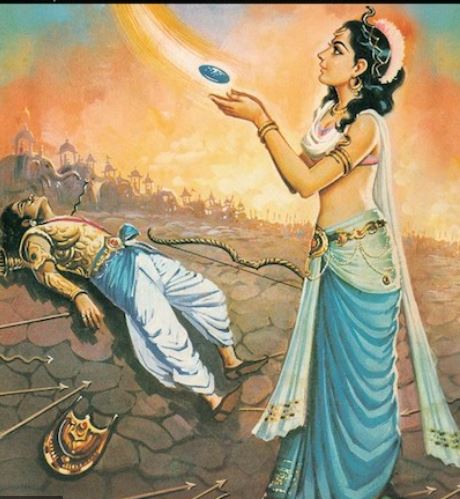
Let’s begin with Ulupi, who revived her dead lover Arjuna with the Mrithasanjivani gem. As Arjuna lay dead, killed by his own son Babruvahana owing to a curse of the Vasus, it was Ulupi, Arjuna’s Naga wife, who summoned the jewel of the Nagas, placed it on Arjuna’s chest and brought him back to life. According to one version of the story, Ulupi plotted the entire drama of the son killing his father in order to redeem Arjuna from the curse of the Vasus for having slain their brother, Bhishma.
Shachi/Indrani
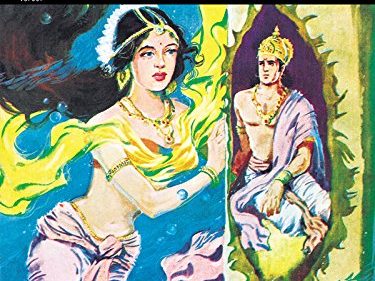
Shachi or Indrani, Indra’s consort, was yet another courageous woman, who was believed to be the source of Indra’s powers. Once, after having killed the demon Vritra treacherously, Indra was so overcome with guilt and shame that he fled Amaravathi, and hid himself in the stem of a lotus in a pond so far away, where he could not be found by other gods.
Unable to find Indra, the gods replaced him with a human, Nahusha. Unfortunately, Nahusha turned out a bad choice as he harassed the gods and the sages, and also tried to persuade Shachi into marrying him.However, clever Shachi managed to get rid of Nahusha by having sage Agasthya curse him into becoming a serpent. She also sought out Indra and convinced him to come out of his hiding and resume his position as the lord of the Devas. Thus, Shachi not only saved her husband from eternal damnation and but also became a kingmaker of sorts, giving back the Devas, their leader.
What makes Shachi’s story interesting is that, in her search for Indra, she is described as having undertaken a long and arduous journey, navigating high mountains and deep seas through darkness and difficulties, very similar to the journey undertaken by Joseph Campbell’s hero.
Damayanti
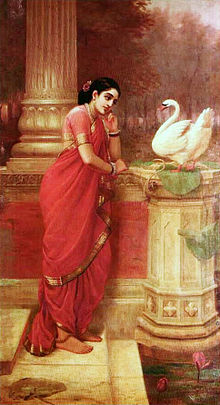
Equally critical was the role of Damayanthi in tracking down Nala, her husband, who had been banished from his kingdom and forced into hiding. Damayanthi hatched a clever plan to track down Nala. Using a difficult riddle which only Nala could solve, she traced him to King Rituparna’s court. There, Damayanthi’s messenger spread false news about her second swayamvara. Hoping to prevent Damayanthi’s remarriage, Nala rushed to her, and was thus reunited with his family.
Savitri
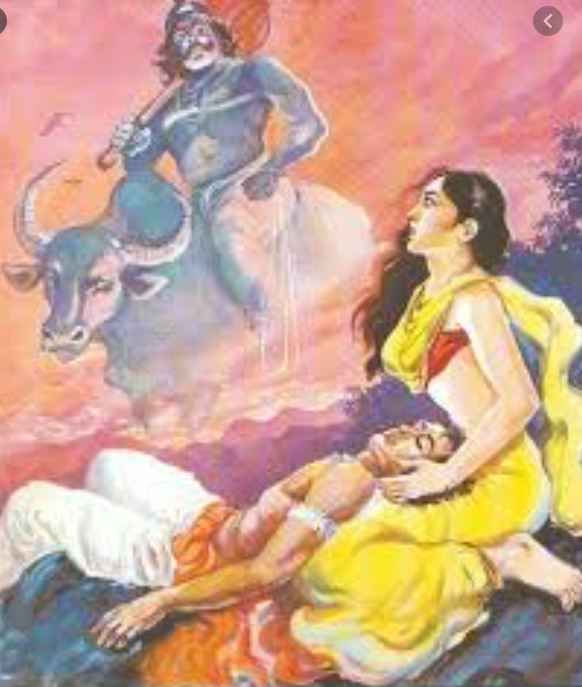
Of course, the list of heroic women from the Mahabharatha cannot be complete without the mention of Savithri, who got none other than the Lord of Death to rewrite the destiny of Satyavan, her beloved. After Satyavan’s death, Savithri followed Yama over long distances on his journey to the land of the dead, till he was forced to yield to the persuasive Savithri and agree to return Satyavan alive to her.
To conclude, it would be unfair to dismiss these mythological women as pativratas, to be lauded merely for their sexual fidelity. It is feminine nature to fiercely protect the loved ones, whatever the cost! And loved their men, these women did! To the extent of even choosing them over gods (Damayanthi) and mighty kings (Savithri) sometimes!
More importantly, like Campbell’s hero, many of these women (Savithri, Shachi) stepped beyond their conventional role, crossing the threshold from the ordinary into the extraordinary, thus undergoing a significant transformation in their personalities in the course of their quest.
In light of these stories, maybe our perception of Indian mythology as having no female heroes needs a serious rethink!
Click the link to listen to the stories of the Panchakanyas, who were as bold as they were beautiful!


 Kulture Katha