The story of Krishna is narrated in several texts including the Hari Vamsa and the Bhagawata Purana. In these texts, he is God – omnipresent and omnipotent.
But in the Mahabharata, he comes across as a complex character in varying shades of white, black, grey and blue. Here, he is not always god, but often a thinker-philosopher and war strategist.
Presenting five lesser-known aspects of Krishna from the Mahabharata.
The Mahabharata is narrated for the first time at a horrific snake sacrifice conducted by Arjuna’s great grandson and Abhimanyu’s grandson, Janamejaya.
But how does the snake sacrifice relate to the core story of the epic? How does the Sarpa Sattra or the snake sacrifice set the perfect context for the epic?
Damsels in distress and knights rushing to rescue them from the clutches of wily witches, scheming step-mothers and dangerous dragons has been the common theme of most fairy tales from our childhood. These stories from medieval Europe have largely presented women as delicate, helpless beings, incapable of defending themselves, and waiting for a valiant prince to arrive and liberate them from their miserable existence.
Surprisingly for a patriarchal society, this theme of men rescuing women is quite rare in Indian mythology, other than, of course, the famous story of Rama who goes out in search of his kidnapped wife.
On the contrary, Indian mythology is full of stories of women who go all out to rescue their lovers or consorts, with or without their shining armour. These women often save their beloveds from tricky tribulations and sticky situations, accompany them to the warfront, and at times even bring them back from the dead.
And the Mahabharata, unlike any other work of world mythology, is replete with stories of women champions. Here are some stories of gutsy women who displayed enormous valour in their quest to bring back their loved ones from the brink and beyond of disaster. What is interesting about these stories is that, unlike men, these women chose to rely entirely on their moral courage, wit and wisdom rather than swords and daggers to assist them in their quest.
Ulupi
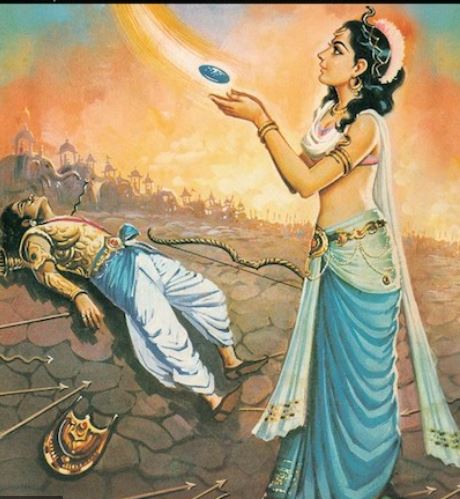
Let’s begin with Ulupi, who revived her dead lover Arjuna with the Mrithasanjivani gem. As Arjuna lay dead, killed by his own son Babruvahana owing to a curse of the Vasus, it was Ulupi, Arjuna’s Naga wife, who summoned the jewel of the Nagas, placed it on Arjuna’s chest and brought him back to life. According to one version of the story, Ulupi plotted the entire drama of the son killing his father in order to redeem Arjuna from the curse of the Vasus for having slain their brother, Bhishma.
Shachi/Indrani
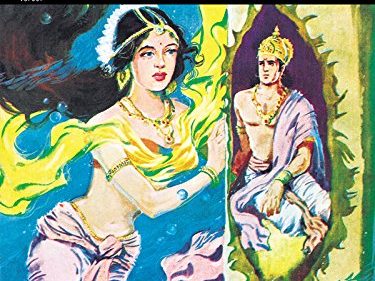
Shachi or Indrani, Indra’s consort, was yet another courageous woman, who was believed to be the source of Indra’s powers. Once, after having killed the demon Vritra treacherously, Indra was so overcome with guilt and shame that he fled Amaravathi, and hid himself in the stem of a lotus in a pond so far away, where he could not be found by other gods.
Unable to find Indra, the gods replaced him with a human, Nahusha. Unfortunately, Nahusha turned out a bad choice as he harassed the gods and the sages, and also tried to persuade Shachi into marrying him.However, clever Shachi managed to get rid of Nahusha by having sage Agasthya curse him into becoming a serpent. She also sought out Indra and convinced him to come out of his hiding and resume his position as the lord of the Devas. Thus, Shachi not only saved her husband from eternal damnation and but also became a kingmaker of sorts, giving back the Devas, their leader.
What makes Shachi’s story interesting is that, in her search for Indra, she is described as having undertaken a long and arduous journey, navigating high mountains and deep seas through darkness and difficulties, very similar to the journey undertaken by Joseph Campbell’s hero.
Damayanti
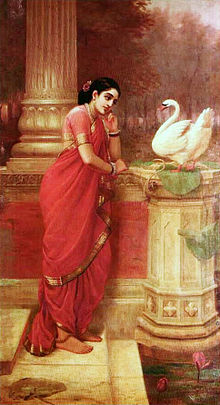
Equally critical was the role of Damayanthi in tracking down Nala, her husband, who had been banished from his kingdom and forced into hiding. Damayanthi hatched a clever plan to track down Nala. Using a difficult riddle which only Nala could solve, she traced him to King Rituparna’s court. There, Damayanthi’s messenger spread false news about her second swayamvara. Hoping to prevent Damayanthi’s remarriage, Nala rushed to her, and was thus reunited with his family.
Savitri
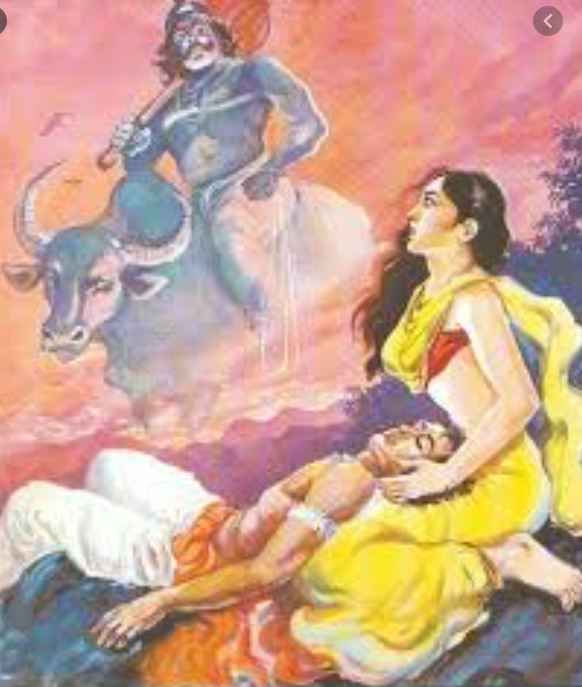
Of course, the list of heroic women from the Mahabharatha cannot be complete without the mention of Savithri, who got none other than the Lord of Death to rewrite the destiny of Satyavan, her beloved. After Satyavan’s death, Savithri followed Yama over long distances on his journey to the land of the dead, till he was forced to yield to the persuasive Savithri and agree to return Satyavan alive to her.
To conclude, it would be unfair to dismiss these mythological women as pativratas, to be lauded merely for their sexual fidelity. It is feminine nature to fiercely protect the loved ones, whatever the cost! And loved their men, these women did! To the extent of even choosing them over gods (Damayanthi) and mighty kings (Savithri) sometimes!
More importantly, like Campbell’s hero, many of these women (Savithri, Shachi) stepped beyond their conventional role, crossing the threshold from the ordinary into the extraordinary, thus undergoing a significant transformation in their personalities in the course of their quest.
In light of these stories, maybe our perception of Indian mythology as having no female heroes needs a serious rethink!
Click the link to listen to the stories of the Panchakanyas, who were as bold as they were beautiful!
Goddess Lakshmi finds mention in an annexure to the oldest of Indian texts, the Rig Veda – the Sri Suktam to be precise.
What is interesting is that she continues to be depicted in popular art based on the descriptions given in the Sri Suktam. And so, we find her sitting on a red lotus in a pool of water, carrying a pot on her hands while two elephants stand on either side showering water on her.
This video explains the significance of each of these elements – the waters, the kumbha/pot, the lotus and the elephants.
Kalidasa’s great epic Kumara Sambhava opens with a salutation to Shiva and Parvati where he refers to them as the parents of the world who are as inseparable as a word and its meaning.
In Indian thought, the title of mother is not just restricted to Parvati but to all our goddesses. They tend to their devotees as a mother tends to her child.
Here’s a sthalapurana of a temple from deep down south, where the goddess rushed to the help of her devout son when he needed her most.
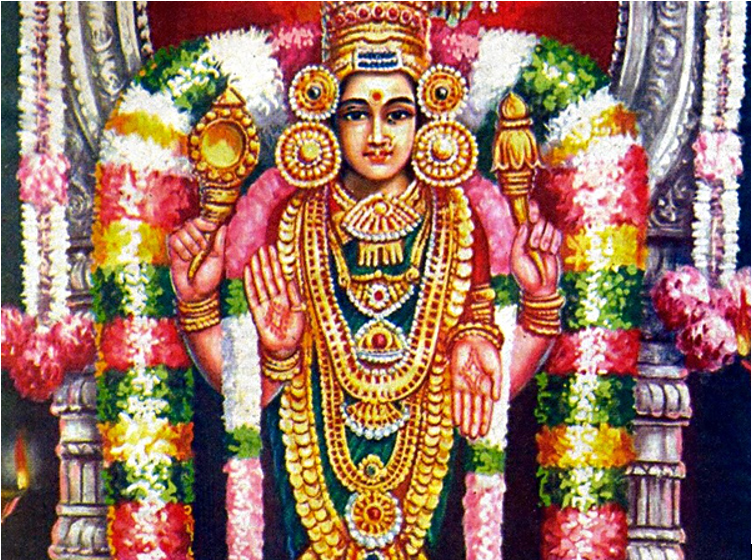
So the story goes that sometime in the 18th century AD, there lived a Brahmin named Subramanyam Iyer in a small town called Thirukadaiyur in Tamil Nadu. His town had a famous Shiva temple where the presiding deity was Lord Amrithaghateswar and his consort was Goddess Abhirami.
Subramanyam was a regular visitor to the temple. He was deeply devoted to Goddess Abhirami. So intense was his faith that he saw the goddess in every woman and much to the discomfort and annoyance of the women in his town, he chased them around and showered them with flowers before prostrating at their feet. This quirky behaviour of his earned him the title of a lunatic.
On one new moon day, the local king Sarfoji, came to the temple for a darshan of the goddess. At the sanctum sanctorum of the temple, he found Subramanyam deep in meditation. Now, the king was used to having people rushing to his beck and call. So, Subramanyam’s complete oblivion to his presence angered him. Sarfoji enquired the locals about Subramanyam and was told that Subramanayam was a mad man.
The king decided to run a test of his own on the man sitting before him. He nudged the meditating Subramanyam and asked him if he knew what day of the lunar month (thithi) it was. Now, everyone knew it was the new moon day (Amavasya), when the night sky would be moon-less and dark. But Subramanyam, whose eyes were fixed on the face of the goddess that looked as bright as the glow of a thousand moons, blurted out that it was a full moon day (Purinma).
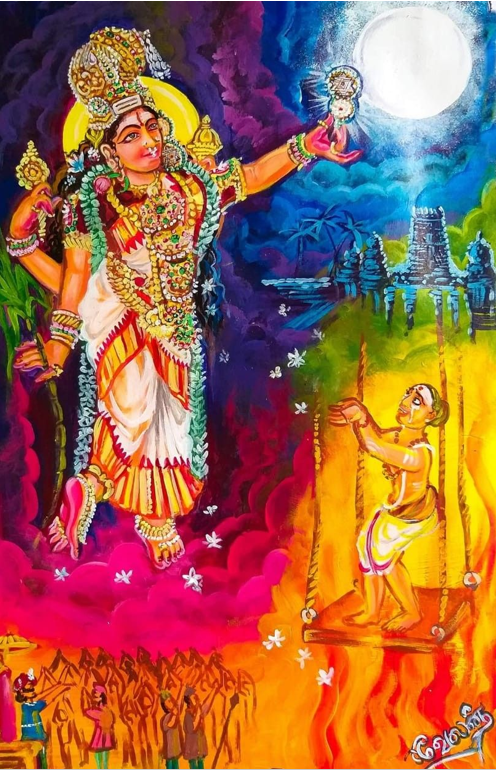
Angered by the wrong answer, the king ordered that Subramanyam be punished. As per the king’s order, Subramanyam was to be suspended on a wooden deck hung over a blazing fire with the help of ropes. The deck hosting Subramanyam was to be purged into the fireplace below, at dusk, if the moon did not rise, as he had predicted.
But, as happens with all men of god, Subramanyam remained unperturbed! It is said that, it was while hovering over the blazing fire that Subramanyam composed and rendered over a 100 hymns in praise of Goddess Abhirami.
After each hymn was rendered, the deck was lowered further. The onlookers waited with bated breath to see what would happen!
Legend has it that just as Subramanyam finished rendering his seventy-ninth hymn, Goddess Abhirami appeared before him, removed her resplendent earring and threw it at the sky where it shone like the silvery moon!
Subramanyam’s words had indeed come true!
On a supposedly no-moon night, there was now a round silvery moon that shone like a brilliant jewel, turning an otherwise dark night sky into a brightly lit celestial canvas.
The king, who witnessed this miracle, realised the extreme devotion of Subramanya Iyer, sought his forgiveness, and set him free.
From that day, Subramanyam came to be known as Abhirami Bhattar. The hymns he composed are known as Abhirami Andhadhi, an exquisite piece of devotional poetry, where every verse starts with the same word that the previous verse ends in.
Abhirami Andhadhi is still read and rendered by millions of Tamils even today. It is believed that rendering these hymns on full moon and new moon days can make the great mother grant the most impossible of her children’s dreams!
AK Ramanujan, the great folklorist from India collected a folktale in which a story and a song once escaped from the mouth of a sleeping woman frustrated that she refused to share them with others. The next morning, when she woke up, she had forgotten both the story and the song that she had kept all to herself.
This folktale illustrates the importance of story-telling for Indians. Stories have a compelling need to be told, listened to and shared. With time, as these stories get told and retold innumerable times in different formats, they evolve into a tradition.
Great epics were composed in Greek (Illiad and Odyssey) and Akkadian (the Sumerian epic of Gilgamesh) too. But today, they remain merely as distant memories from a forgotten past. Whereas, Ramayana remains a living tradition and continues to fascinate and enrich the minds of every passing generation.
Ramayana, the first Indian epic
In the Indian culture, the Valmiki Ramayana, dated to approximately 3rd century BCE, is considered the Adi Kavya or the first poetic composition in Sanskrit of epic proportions. No other composition earlier had had the vastness or richness of the plot that Ramayana had. No other story had reflected the ethics and value system of a society as the story of Rama did. Everyone loves a good tragedy, as Aristotle’s idea of catharsis would tell us. The most enduring stories told, we often find, are either tragedies or love stories. Ramayana, brimming with karuna rasa, was both – a tragic love-story – and therein lay its eternal appeal. The message that God too was bound by the laws of destiny and suffered very human problems struck a chord with the common man facing societal pressures and challenges.
How the epic spread across the Indian subcontinent….
As Adi Kavya, Ramayana became the first or the basic template of a story for all future stories and epics. Several later mythological compositions and religious texts borrowed the textual template from Ramayana. The influence of Ramayana was so profound that almost all the Hindu religious literature ever composed including the Mahabharata and the Shaiva and Vaishnava Puranas narrate the story of Rama.
But imitation, as they say, is the best form of flattery. Valmiki’s composition set forth an explosion of texts, in Sanskrit, Prakrit as well all as the vernacular resulting in at least 300 different retellings of the epic. With every retelling, Rama’s story diffused into the local culture and gradually emerged as the common denominator that united people of diverse ethnicity and culture across the Indian subcontinent.
Ramayana presented the retellers with a staple story and a set of archetypal characters that were suitably altered to fit the milieu. The language changed, the names changed, the relationships between the cameos changed, but the key characters (Rama, Sita, Lakshmana, Hanuman and Ravana) and episodes from the epic more or less remained the same. The mode of transmission of the Ramayana was not all textual.
In a sense, Ramayana, which literally means the path of Rama, is a travel story. Rama travels through a very long route called the Dakshinapath that ran from Ayodhya in the north to Rameshwaram in the south, on his search for Sita.
Even as Rama’s adventures took him down south, Valmiki wove into it previously unknown details of the geography, and flora and fauna of peninsular India, along with an account of the lifestyles of the smaller clans and tribes that inhabited these parts. In as much as these details added to the epic’s novelty value, they also widened the reach of the epic through associations of certain sacred geography with specific episodes from the epic.
Ramayana in Indian art
Apart from oral renditions, the story of Rama reached the largely illiterate audience in the form of folk and classical dances, songs, theatre, shadow-plays that used puppets, etc. The Ramayana was also presented as the theatrical re-enactment of Rama’s life (Ramlila) and through scroll painting traditions (that support oral story telling with visual props) such as the Phad tradition from Bhilwara, Rajasthan and Kalamkari painting tradition from Kalahasti, Andhra Pradesh.
These art forms borrowed the epic’s basic idea and adapted it to suit the local belief systems, social structure and values. Characters such as Lakshmana and Shurpanaka were assimilated into the native culture and embedded into the local tales, where they freely intermingled with other indigenous characters. For instance, in the Phad story telling tradition, the protagonist Papuji is believed to have been Lakshmana in his previous birth and had married Shurpanakha.
Architecture too developed around the characters and episodes from the epic. The relief at the Prambanan temple complex at Java depicting episodes from the Ramayana and the relief work showing Ravana trying to lift Mount Kailash at Ellora caves are some of the finest examples of story-telling in stone, that were inspired by the epic.
From classical to folk renderings, the story gradually travelled inlands and diffused into the mythology of the tribals too. Gond Ramayani and Bhil Ramayan are two well-known tribal versions of the epic. While Gond Ramayani narrates the story of Lakshmana’s hunt for a bride, in the Bhil Ramayana, Ravana does not battle Rama but returns Sita to him after realizing his blunder.
…….to be continued
Coming up!
Part 2 – How & Why the story of Rama spread beyond India, and other Asian versions of the epic
Check out the Jain version of the Ramayana by clicking the video link:
India’s Deccan plateau, that was formed out of a volcanic eruption millions of years ago, was the first place on earth where diamonds were mined.
In India, these precious stones were believed to possess miraculous powers. Flawless gems, it was thought, brought good fortune to the owner in the form of long life, good health and prosperity. Whereas, flawed gems brought the opposite effects.
Power and purity of these precious stones, thus become the most common motifs in our stories.
Watch the video to listen to interesting and intriguing stories about pearls and precious stones!
India, since ancient times, has been a gold-crazy country. For all the spices, silks and muslin it traded with the Roman empire, India received its payment in gold.
At a point in time, so much of gold was flowing out of the Roman empire for settling balance of payments with India that, a Roman senator feared that his empire would go bankrupt!
With so much love for gold, it is hardly surprising that jewellery had an important role to play in our stories.
Watch the video to find out how gold and jewellery have been used with great imagination and creativity in out stories!


 Kulture Katha