There are many stories and events in the Mahabharata that appear to contradict each other.
Some stories urge us to embrace life, while some other suggest we give it up. Some stories recommend rituals while some others point to their futility.
Why does the epic present such contradictory ideas ? And how do we understand them?
Listen in to know the how and the why and also find the secret thread that binds these varied ideas together to make the epic work like a single, unified text!
Damsels in distress and knights rushing to rescue them from the clutches of wily witches, scheming step-mothers and dangerous dragons has been the common theme of most fairy tales from our childhood. These stories from medieval Europe have largely presented women as delicate, helpless beings, incapable of defending themselves, and waiting for a valiant prince to arrive and liberate them from their miserable existence.
Surprisingly for a patriarchal society, this theme of men rescuing women is quite rare in Indian mythology, other than, of course, the famous story of Rama who goes out in search of his kidnapped wife.
On the contrary, Indian mythology is full of stories of women who go all out to rescue their lovers or consorts, with or without their shining armour. These women often save their beloveds from tricky tribulations and sticky situations, accompany them to the warfront, and at times even bring them back from the dead.
And the Mahabharata, unlike any other work of world mythology, is replete with stories of women champions. Here are some stories of gutsy women who displayed enormous valour in their quest to bring back their loved ones from the brink and beyond of disaster. What is interesting about these stories is that, unlike men, these women chose to rely entirely on their moral courage, wit and wisdom rather than swords and daggers to assist them in their quest.
Ulupi
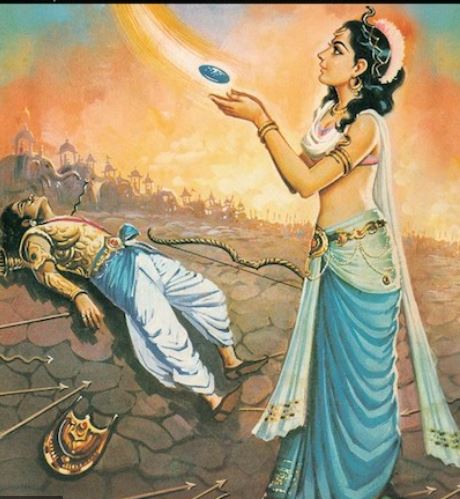
Let’s begin with Ulupi, who revived her dead lover Arjuna with the Mrithasanjivani gem. As Arjuna lay dead, killed by his own son Babruvahana owing to a curse of the Vasus, it was Ulupi, Arjuna’s Naga wife, who summoned the jewel of the Nagas, placed it on Arjuna’s chest and brought him back to life. According to one version of the story, Ulupi plotted the entire drama of the son killing his father in order to redeem Arjuna from the curse of the Vasus for having slain their brother, Bhishma.
Shachi/Indrani
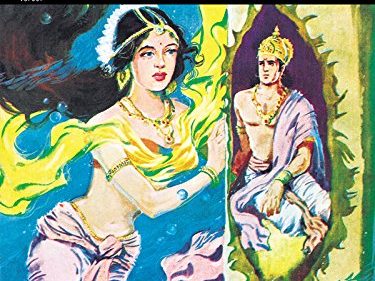
Shachi or Indrani, Indra’s consort, was yet another courageous woman, who was believed to be the source of Indra’s powers. Once, after having killed the demon Vritra treacherously, Indra was so overcome with guilt and shame that he fled Amaravathi, and hid himself in the stem of a lotus in a pond so far away, where he could not be found by other gods.
Unable to find Indra, the gods replaced him with a human, Nahusha. Unfortunately, Nahusha turned out a bad choice as he harassed the gods and the sages, and also tried to persuade Shachi into marrying him.However, clever Shachi managed to get rid of Nahusha by having sage Agasthya curse him into becoming a serpent. She also sought out Indra and convinced him to come out of his hiding and resume his position as the lord of the Devas. Thus, Shachi not only saved her husband from eternal damnation and but also became a kingmaker of sorts, giving back the Devas, their leader.
What makes Shachi’s story interesting is that, in her search for Indra, she is described as having undertaken a long and arduous journey, navigating high mountains and deep seas through darkness and difficulties, very similar to the journey undertaken by Joseph Campbell’s hero.
Damayanti
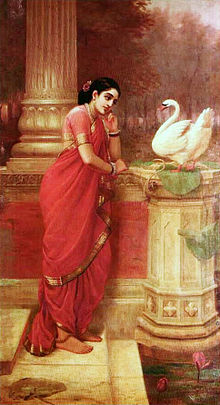
Equally critical was the role of Damayanthi in tracking down Nala, her husband, who had been banished from his kingdom and forced into hiding. Damayanthi hatched a clever plan to track down Nala. Using a difficult riddle which only Nala could solve, she traced him to King Rituparna’s court. There, Damayanthi’s messenger spread false news about her second swayamvara. Hoping to prevent Damayanthi’s remarriage, Nala rushed to her, and was thus reunited with his family.
Savitri
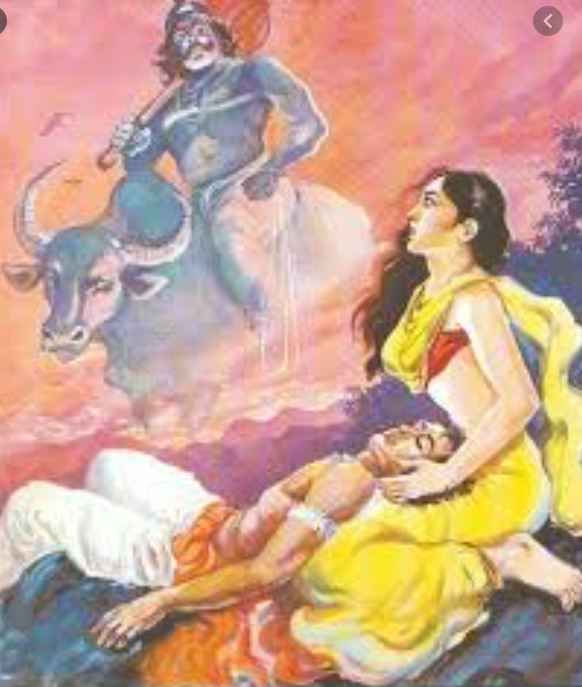
Of course, the list of heroic women from the Mahabharatha cannot be complete without the mention of Savithri, who got none other than the Lord of Death to rewrite the destiny of Satyavan, her beloved. After Satyavan’s death, Savithri followed Yama over long distances on his journey to the land of the dead, till he was forced to yield to the persuasive Savithri and agree to return Satyavan alive to her.
To conclude, it would be unfair to dismiss these mythological women as pativratas, to be lauded merely for their sexual fidelity. It is feminine nature to fiercely protect the loved ones, whatever the cost! And loved their men, these women did! To the extent of even choosing them over gods (Damayanthi) and mighty kings (Savithri) sometimes!
More importantly, like Campbell’s hero, many of these women (Savithri, Shachi) stepped beyond their conventional role, crossing the threshold from the ordinary into the extraordinary, thus undergoing a significant transformation in their personalities in the course of their quest.
In light of these stories, maybe our perception of Indian mythology as having no female heroes needs a serious rethink!
Click the link to listen to the stories of the Panchakanyas, who were as bold as they were beautiful!
Everyone knows that the Mahabharata is an epic! The longest poem of the world! A great piece of world literature!
But how many of us actually know about the nature of the epic?
Apart from the core narrative of the rift in the Kuru family, the epic has several layers of content containing long discourses on politics and statecraft, several teachings for the common man to help him lead his everyday life, detailed descriptions on various religious doctrines and last but not the least, the crest jewel of Indian philosophy, the Bhagawad Gita.,,,,
Phew! That was a long list….Oh! Wait! Don’t forget the 67 sub-tales called Upakhyanas and hundreds of small and big fables, parables, folklore, myths and legends!
Because of its vast size and extreme complexity of its contents, the epic has even been described as a monstrous chaos!
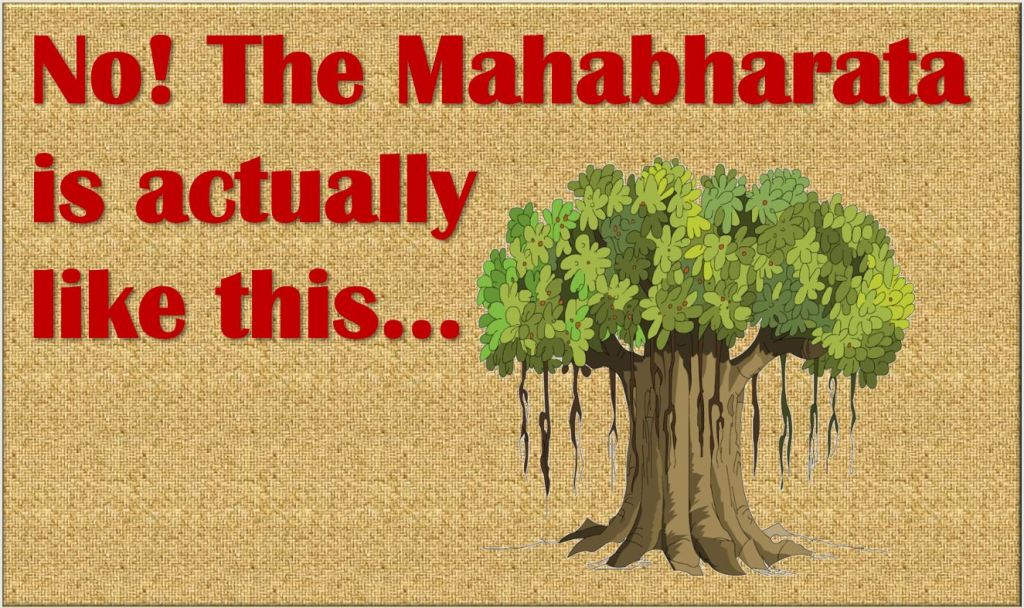
So, is the Mahabharata something like this?
No! Say those who have studied the epic in-depth and seen its underlying patterns. They say, the Mahabharata is like the banyan tree….
Andal, the only female Alvar, is known for her two compositions – Thiruppavai and Nachiyar Thirumozhi.
While the central theme of Thiruppavai is devotion, her composition Nachiyar Thirumozhi brims with erotic passion for the divine. This kind of Madhurya Bhakti is rather unique to the Indian Bhakti tradition and the Alvars are believed to have pioneered literature based on Viraha Bhakti.
How do we understand Andal’s love?
This video attempts to explore what her expressions of desire and longing for her divine lover mean and what inspired her to compose these poems of love!
Andal was the only female to be counted among the 12 ardent devotees of Vishnu called the Alvars.
She is credited with two works that are hailed both for their expression of devotion as well as their erotic and literary beauty – Thiruppavai and Nachiyar Thirumozhi.
This video tells the story of Andal, her pining and longing to unite with her lover lord, and the final fulfillment of her desire. The video also includes rendering of some of Andal’s verses by a trained Carnatic vocalist.
Goddess Lakshmi finds mention in an annexure to the oldest of Indian texts, the Rig Veda – the Sri Suktam to be precise.
What is interesting is that she continues to be depicted in popular art based on the descriptions given in the Sri Suktam. And so, we find her sitting on a red lotus in a pool of water, carrying a pot on her hands while two elephants stand on either side showering water on her.
This video explains the significance of each of these elements – the waters, the kumbha/pot, the lotus and the elephants.
Indian mythology is replete with stories where wives and lady loves undertake extraordinary journeys to save their beloveds from tricky tribulations and sticky situations, at times even bringing them back from the dead. The stories of Satyavan-Savitri, Nala-Damayanti, Arjuna-Ulupi show how women moved heaven and earth for the sake of the men they loved.
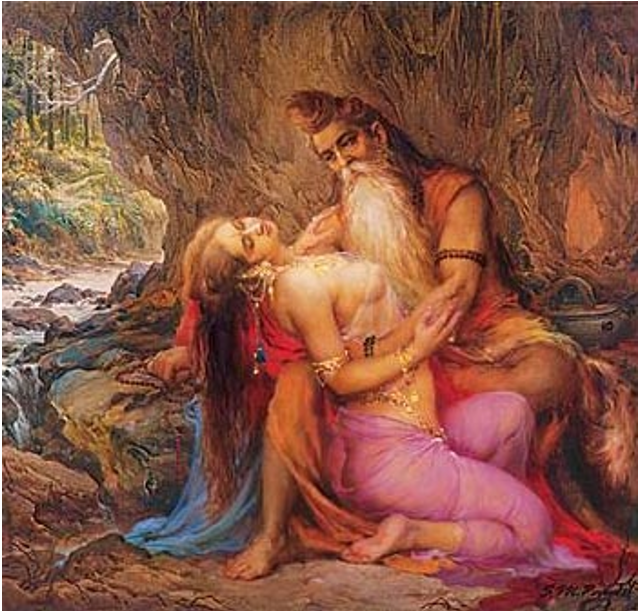
But, it’s not often that one finds stories of a husband or lover who is willing to walk the extra mile for the sake of his lady love or wife. In that sense, the story of Ruru and Pramadvara that finds mention in the Adi Parva (Pouloma sub-parvan) of the Mahabharata is unique for it illustrates that a man too is capable of as much love as a woman.
Ruru was born in the illustrious line of Sage Bhrigu. He was the son of Pramati, who was the grandson of Sage Bhrigu.
When Ruru was a grown man, one day he happened to see Pramadvara, the beautiful damsel born to the Apsara, Menaka and Vishvavasu, the king of the Gandharvas. Immediately after her birth, Pramadvara had been abandoned by Menaka on a river bank. A sage named Sthulakesha had found the girl child and had brought her up as his own. With time, Pramadvara had blossomed into a beautiful woman.
So, when Ruru first set his eyes on Menaka’s daughter, he was smitten. Soon, with the blessings of his father- Pramati. and Pramadvara’s foster father- Sthulakesha, Ruru and Pramadvara were engaged to be married. A wedding date was fixed and, the young couple started to look forward to their marital union.
However, it turned out that cruel destiny had different plans for them.
One day, when Pramadvara was playing with her friends in the forest, a venomous snake sunk it fangs into the body of the girl. As soon as she was bitten, Pramdvara fell down senseless on the ground. On hearing the news, Ruru rushed to see his beloved and was overwhelmed with grief to see the beautiful Pramadvara lying dead on the ground.
Unable to bear the sight of his dead lady love, Ruru wept loudly. He cried out loud saying if indeed he had remained true to his austerities as a Brahmin, had performed the prescribed rites, respected the elders and had selflessly given away alms, then his dear Pramadvara would have to rise from the dead.
On hearing Ruru’s lamentations, the messenger of the gods responded saying that no amount of bemoaning by Ruru could help Pramadvara, for once the mortal life of a person was over, there were no means of reviving them.
However, the messenger offered a consolation….there was one way by which Pramadvara could be brought back to life. If Ruru was ready to give up half of his life for Pramadvara, she could be brought back from the land of the dead. Hearing this, Ruru was overcome with joy. He readily agreed to give up half of his long life span for his dear, beloved Pramadvara.
At once, the permission of Yama – the lord of death was sought. Yama consented to allow Ruru to revive Pramadvara. Immediately thereafter, Pramadvara arose from the dead, lovely as ever, filling the grieving Ruru’s heart with untold joy. The lover couple was ecstatic to be back together again.
Ruru and Pramadvara were married shortly thereafter, and the couple spent many a wonderful year rejoicing in each other’s company.
Thus, Ruru stands tall among men, who are capable of as much love as a woman, and can even make the ultimate sacrifice of partaking their lives with their lady loves.
The idea of a the dancing god is unique to Indian culture. And Nataraja is believed to be the king of dance.
This video explores the mythological, cosmic and spiritual symbolism hidden in the iconography of Nataraja. It also features two classical renderings of Shiva’s dance.


 Kulture Katha