Mahabharata the epic has captured and held the imagination of Indians for over two millennia.
The epic has inspired scores of literary works over the years. So, it’s hardly surprising that the epic also inspired several sculptors to tell its story in stone.
Proud to present some stories from the epic that found expression in the temples of Belur and Halebidu.
The story of Krishna is narrated in several texts including the Hari Vamsa and the Bhagawata Purana. In these texts, he is God – omnipresent and omnipotent.
But in the Mahabharata, he comes across as a complex character in varying shades of white, black, grey and blue. Here, he is not always god, but often a thinker-philosopher and war strategist.
Presenting five lesser-known aspects of Krishna from the Mahabharata.
The Mahabharata is narrated for the first time at a horrific snake sacrifice conducted by Arjuna’s great grandson and Abhimanyu’s grandson, Janamejaya.
But how does the snake sacrifice relate to the core story of the epic? How does the Sarpa Sattra or the snake sacrifice set the perfect context for the epic?
There are many stories and events in the Mahabharata that appear to contradict each other.
Some stories urge us to embrace life, while some other suggest we give it up. Some stories recommend rituals while some others point to their futility.
Why does the epic present such contradictory ideas ? And how do we understand them?
Listen in to know the how and the why and also find the secret thread that binds these varied ideas together to make the epic work like a single, unified text!
Everyone knows that the Mahabharata is an epic! The longest poem of the world! A great piece of world literature!
But how many of us actually know about the nature of the epic?
Apart from the core narrative of the rift in the Kuru family, the epic has several layers of content containing long discourses on politics and statecraft, several teachings for the common man to help him lead his everyday life, detailed descriptions on various religious doctrines and last but not the least, the crest jewel of Indian philosophy, the Bhagawad Gita.,,,,
Phew! That was a long list….Oh! Wait! Don’t forget the 67 sub-tales called Upakhyanas and hundreds of small and big fables, parables, folklore, myths and legends!
Because of its vast size and extreme complexity of its contents, the epic has even been described as a monstrous chaos!
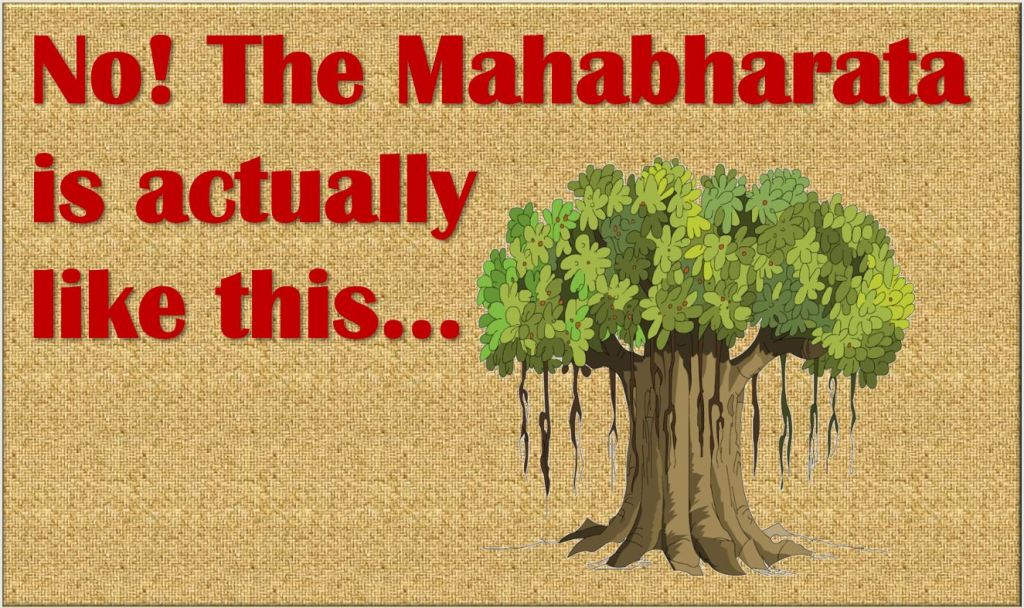
So, is the Mahabharata something like this?
No! Say those who have studied the epic in-depth and seen its underlying patterns. They say, the Mahabharata is like the banyan tree….


 Kulture Katha