When the Mother showed the moon to save her son…

Kalidasa’s great epic Kumara Sambhava opens with a salutation to Shiva and Parvati where he refers to them as the parents of the world who are as inseparable as a word and its meaning.

In Indian thought, the title of mother is not just restricted to Parvati but to all our goddesses. They tend to their devotees as a mother tends to her child.

Here’s a sthalapurana of a temple from deep down south, where the goddess rushed to the help of her devout son when he needed her most.

So the story goes that sometime in the 18th century AD, there lived a Brahmin named Subramanyam Iyer in a small town called Thirukadaiyur in Tamil Nadu. His town had a famous Shiva temple where the presiding deity was Lord Amrithaghateswar and his consort was Goddess Abhirami.
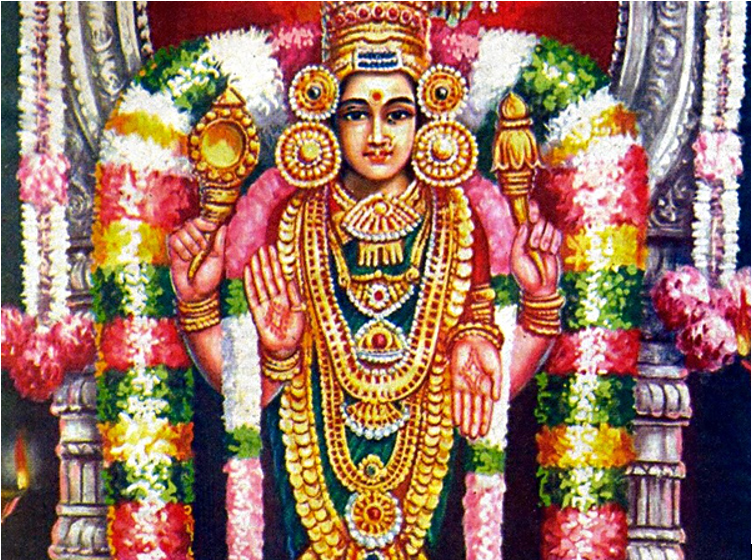
Subramanyam was a regular visitor to the temple. He was deeply devoted to Goddess Abhirami. So intense was his faith that he saw the goddess in every woman and much to the discomfort and annoyance of the women in his town, he chased them around and showered them with flowers before prostrating at their feet. This quirky behaviour of his earned him the title of a lunatic.

On one new moon day, the local king Sarfoji, came to the temple for a darshan of the goddess. At the sanctum sanctorum of the temple, he found Subramanyam  deep in meditation. Now, the king was used to having people rushing to his beck and call. So, Subramanyam’s complete oblivion to his presence angered him. Sarfoji enquired the locals about Subramanyam and was told that Subramanayam was a mad man.

The king decided to run a test of his own on the man sitting before him. He nudged the meditating Subramanyam and asked him if he knew what day of the lunar month (thithi) it was. Now, everyone knew it was the new moon day (Amavasya), when the night sky would be moon-less and dark. But Subramanyam, whose eyes were fixed on the face of the goddess that looked as bright as the glow of a thousand moons, blurted out that it was a full moon day (Purinma).

Angered by the wrong answer, the king ordered that Subramanyam be punished. As per the king’s order, Subramanyam was to be suspended on a wooden deck hung over a blazing fire with the help of ropes. The deck hosting Subramanyam was to be purged into the fireplace below, at dusk, if the moon did not rise, as he had predicted.

But, as happens with all men of god, Subramanyam remained unperturbed! It is said that, it was while hovering over the blazing fire that Subramanyam composed and rendered over a 100 hymns in praise of Goddess Abhirami.

After each hymn was rendered, the deck was lowered further. The onlookers waited with bated breath to see what would happen!

Legend has it that just as Subramanyam finished rendering his seventy-ninth hymn, Goddess Abhirami appeared before him, removed her resplendent earring and threw it at the sky where it shone like the silvery moon!
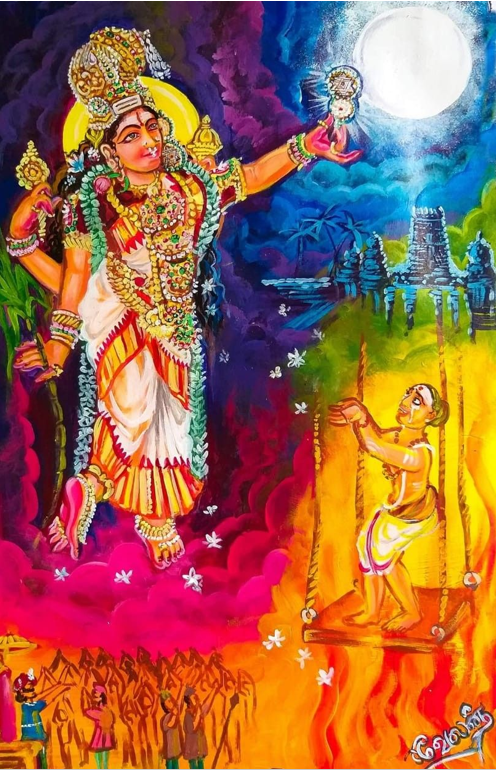
Subramanyam’s words had indeed come true!

On a supposedly no-moon night, there was now a round silvery moon that shone like a brilliant jewel, turning an otherwise dark night sky into a brightly lit celestial canvas.

The king, who witnessed this miracle, realised the extreme devotion of Subramanya Iyer, sought his forgiveness, and set him free.

From that day, Subramanyam came to be known as Abhirami Bhattar. The hymns he composed are known as Abhirami Andhadhi, an exquisite piece of devotional poetry, where every verse starts with the same word that the previous verse ends in.

Abhirami Andhadhi is still read and rendered by millions of Tamils even today. It is believed that rendering these hymns on full moon and new moon days can make the great mother grant the most impossible of her children’s dreams!
The man who loved like a woman…


Ruru & Pramadvara – A story from the Mahabharata

Indian mythology is replete with stories where wives and lady loves undertake extraordinary journeys to save their beloveds from tricky tribulations and sticky situations, at times even bringing them back from the dead.  The stories of Satyavan-Savitri, Nala-Damayanti, Arjuna-Ulupi show how women moved heaven and earth for the sake of the men they loved.

But, it’s not often that one finds stories of a husband or lover who is willing to walk the extra mile for the sake of his lady love or wife. In that sense, the story of Ruru and Pramadvara that finds mention in the Adi Parva (Pouloma sub-parvan) of the Mahabharata is unique for it illustrates that a man too is capable of as much love as a woman.

Ruru was born in the illustrious line of Sage Bhrigu. He was the son of Pramati, who was the grandson of Sage Bhrigu.

When Ruru was a grown man, one day he happened to see Pramadvara, the beautiful damsel born to the Apsara, Menaka and Vishvavasu, the king of the Gandharvas. Immediately after her birth, Pramadvara had been abandoned by Menaka on a river bank. A sage named Sthulakesha had found the girl child and had brought her up as his own. With time, Pramadvara had blossomed into a beautiful woman.

So, when Ruru first set his eyes on Menaka’s daughter, he was smitten.  Soon, with the blessings of his father- Pramati. and Pramadvara’s foster father- Sthulakesha, Ruru and Pramadvara were engaged to be married. A wedding date was fixed and, the young couple started to look forward to their marital union.

However, it turned out that cruel destiny had different plans for them.

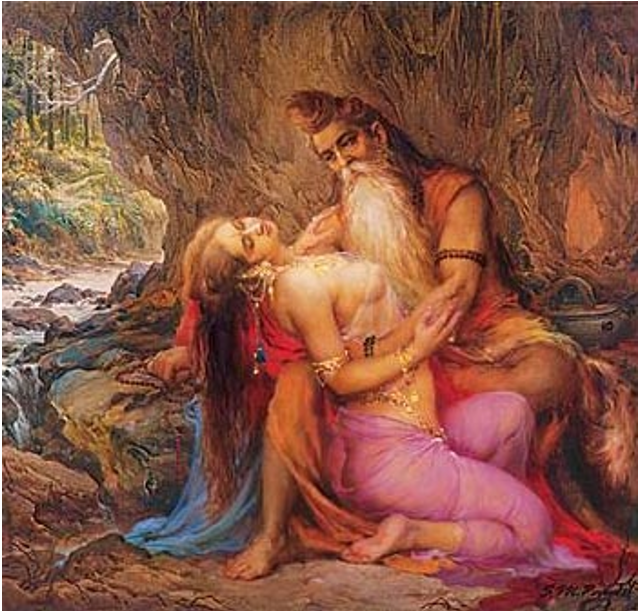
One day, when Pramadvara was playing with her friends in the forest, a venomous snake sunk it fangs into the body of the girl. As soon as she was bitten, Pramdvara fell down senseless on the ground.  On hearing the news, Ruru rushed to see his beloved and was overwhelmed with grief to see the beautiful Pramadvara lying dead on the ground.

Unable to bear the sight of his dead lady love, Ruru wept loudly.  He cried out loud saying if indeed he had remained true to his austerities as a Brahmin, had performed the prescribed rites, respected the elders and had selflessly given away alms, then his dear Pramadvara would have to rise from the dead.

On hearing Ruru’s lamentations, the messenger of the gods responded saying that no amount of bemoaning by Ruru could help Pramadvara, for once the mortal life of a person was over, there were no means of reviving them.

However, the messenger offered a consolation….there was one way by which Pramadvara could be brought back to life. If Ruru was ready to give up half of his life for Pramadvara, she could be brought back from the land of the dead. Hearing this, Ruru was overcome with joy. He readily agreed to give up half of his long life span for his dear, beloved Pramadvara.

At once, the permission of Yama – the lord of death was sought. Yama consented to allow Ruru to revive Pramadvara.  Immediately thereafter, Pramadvara arose from the dead, lovely as ever, filling the grieving Ruru’s heart with untold joy. The lover couple was ecstatic to be back together again.

Ruru and Pramadvara were married shortly thereafter, and the couple spent many a wonderful year rejoicing in each other’s company.

Thus, Ruru stands tall among men, who are capable of as much love as a woman, and can even make the ultimate sacrifice of partaking their lives with their lady loves.

Ramayana: The Greatest Story Ever Told….Part 1

AK Ramanujan, the great folklorist from India collected  a folktale in which a story and a song once escaped from the mouth of a sleeping woman frustrated that she refused to share them with others. The next morning, when she woke up, she had forgotten both the story and the song that she had kept all to herself.  

This folktale illustrates the importance of story-telling for Indians. Stories have a compelling need to be told, listened to and shared. With time, as these stories get told and retold innumerable times in different formats, they evolve into a tradition. 

Great epics were composed in Greek (Illiad and Odyssey) and Akkadian (the Sumerian epic of Gilgamesh) too. But today, they remain merely as distant memories from a forgotten past. Whereas, Ramayana remains a living tradition and continues to fascinate and enrich the minds of every passing generation.

Ramayana, the first Indian epic

In the Indian culture, the Valmiki Ramayana, dated to approximately 3rd century BCE, is considered the Adi Kavya or the first poetic composition in Sanskrit of epic proportions. No other composition earlier had had the vastness or richness of the plot that Ramayana had.  No other story had reflected the ethics and value system of a society as the story of Rama did.
Everyone loves a good tragedy, as Aristotle’s idea of catharsis would tell us. The most enduring stories told, we often find, are either tragedies or love stories. Ramayana, brimming with karuna rasa, was both – a tragic love-story – and therein lay its eternal appeal. The message that God too was bound by the laws of destiny and suffered very human problems struck a chord with the common man facing societal pressures and challenges.

How the epic spread across the Indian subcontinent….

As Adi Kavya, Ramayana became the first or the basic template of a story for all future stories and epics. Several later mythological compositions and religious texts borrowed the textual template from Ramayana. The influence of Ramayana was so profound that almost all the Hindu religious literature ever composed including the Mahabharata and the Shaiva and Vaishnava Puranas narrate the story of Rama.

But imitation, as they say, is the best form of flattery. Valmiki’s composition set forth an explosion of texts, in Sanskrit, Prakrit as well all as the vernacular resulting in at least 300 different retellings of the epic. With every retelling, Rama’s story diffused into the local culture and gradually emerged as the common denominator that united people of diverse ethnicity and culture across the Indian subcontinent.

Ramayana presented the retellers with a staple story and a set of archetypal characters that were suitably altered to fit the milieu. The language changed, the names changed, the relationships between the cameos changed, but the key characters (Rama, Sita, Lakshmana, Hanuman and Ravana) and episodes from the epic more or less remained the same.
The mode of transmission of the Ramayana was not all textual.

In a sense, Ramayana, which literally means the path of Rama, is a travel story. Rama travels through a very long route called the Dakshinapath that ran from Ayodhya in the north to Rameshwaram in the south, on his search for Sita.

Even as Rama’s adventures took him down south, Valmiki wove into it previously unknown details of the geography, and flora and fauna of peninsular India, along with an account of the lifestyles of the smaller clans and tribes that inhabited these parts. In as much as these details added to the epic’s novelty value, they also widened the reach of the epic through associations of certain sacred geography with specific episodes from the epic.

Ramayana in Indian art

Apart from oral renditions, the story of Rama reached the largely illiterate audience in the form of folk and classical dances, songs, theatre, shadow-plays that used puppets, etc. The Ramayana was also presented as the theatrical re-enactment of Rama’s life (Ramlila) and through scroll painting traditions (that support oral story telling with visual props) such as the Phad tradition from Bhilwara, Rajasthan and Kalamkari painting tradition from Kalahasti, Andhra Pradesh. 

These art forms borrowed the epic’s basic idea and adapted it to suit the local belief systems, social structure and values. Characters such as Lakshmana and Shurpanaka were assimilated into the native culture and embedded into the local tales, where they freely intermingled with other indigenous characters.  For instance, in the Phad story telling tradition, the protagonist Papuji is believed to have been Lakshmana in his previous birth and had married Shurpanakha.

Architecture too developed around the characters and episodes from the epic. The relief at the Prambanan temple complex at Java depicting episodes from the Ramayana and the relief work showing Ravana trying to lift Mount Kailash at Ellora caves are some of the finest examples of story-telling in stone, that were inspired by the epic.

From classical to folk renderings, the story gradually travelled inlands and diffused into the mythology of the tribals too. Gond Ramayani and Bhil Ramayan are two well-known tribal versions of the epic. While Gond Ramayani narrates the story of Lakshmana’s hunt for a bride, in the Bhil Ramayana, Ravana does not battle Rama but returns Sita to him after realizing his blunder.

…….to be continued

Coming up!

Part 2 – How & Why the story of Rama spread beyond India, and other Asian versions of the epic

Check out the Jain version of the Ramayana by clicking the video link:

Pearls & Precious Stones in Indian stories

India’s Deccan plateau, that was formed out of a volcanic eruption millions of years ago, was the first place on earth where diamonds were mined.

In India, these precious stones were believed to possess miraculous powers. Flawless gems, it was thought, brought good fortune to the owner in the form of long life, good health and prosperity. Whereas, flawed gems brought the opposite effects.

Power and purity of these precious stones, thus become the most common motifs in our stories.

Watch the video to listen to interesting and intriguing stories about pearls and precious stones!

Gems & Jewellery in Indian Mythology

India, since ancient times, has been a gold-crazy country. For all the spices, silks and muslin it traded with the Roman empire, India received its payment in gold.

At a point in time, so much of gold was flowing out of the Roman empire for settling balance of payments with India that, a Roman senator feared that his empire would go bankrupt!

With so much love for gold, it is hardly surprising that jewellery had an important role to play in our stories.

Watch the video to find out how gold and jewellery have been used with great imagination and creativity in out stories!

7 things you didn’t known about Indian weddings!

In a ritual-ridden society such as ours, it’s no surprise that wedding rituals are given a lot of importance. Yet, many of us are unaware of the significance or relevance of various marriage rituals that are a product of various cross-cultural influences.

This video attempts to bust certain misconceptions relating to Vedic Weddings, as they are performed today and throw light on the non-Vedic origins of some our present-day marriage traditions.

Kottravai, the war goddess of the Tamils

Mother goddess cult is deeply entrenched in Indian culture. Small groups and tribes that lay scattered all across India have had their own specific mother goddess worship traditions.

In what is known as the Sangam age (3rd century BCE to 3rd century CE), Kottravai was worshipped as the war goddess in the arid or desert landscapes of ancient Tamilagam (today’s Tamil Nadu).

Similarly, the origins of the war goddess Durga is traced to certain tribes that lived on the the hills of the Vindya mountains (hence, the deity is also referred to as Vindyavasini).

Over time, with the intermingling of the northern and southern cultures, Kottravai gradually began to be identified with Durga-Parvati.

This video discusses the various references to Kottravai that we find in ancient Tamil literature and through these references, traces the metamorphosis of Kottravai into Durga-Parvati.

The Dance of Shiva

The idea of a the dancing god is unique to Indian culture. And Nataraja is believed to be the king of dance.

This video explores the mythological, cosmic and spiritual symbolism hidden in the iconography of Nataraja. It also features two classical renderings of Shiva’s dance.

Why did Draupadi have five husbands?

The great Indian epic, the Mahabharata, is full of riddles, puzzles and dilemmas. The epic poses several intriguing problems that make us wonder, who was right and who was wrong, who was good and who was bad…

But the one big question about the epic that baffles us no end is about Draupadi….

Why did she have five husbands?

Was Draupadi a victim of fraternal polyandry – a system where all the brothers in a family married the same woman to prevent land fragmentation?

Or was this Kunti’s idea to use Draupadi as the glue to keep her sons struck together?

Or, was poor Draupadi merely a pawn in the game fought by Pandavas and Kauravas for land?

Watch the video to know the answer to the trickiest riddle posed by the Mahabharata!

Was the Agnipariksha a test for Rama?

For many Indians, Rama is god, and Ramayana is a holy text. Yet, there are some episodes in the epic that seem irreconcilable with the immaculate character of Rama, the most contentious being Sita’s agnipariksha.

Was Rama being unfair to Sita in urging her to take the trial by fire to prove her chastity?

Are we being fair to Rama when we try to judge him with our modern day yardstick?

How does Valmiki narrate this episode?

Do watch my video on Kulture Katha on whether the trial by fire was for Sita or, for Rama?!