AK Ramanujan, the great folklorist from India collected a folktale in which a story and a song once escaped from the mouth of a sleeping woman frustrated that she refused to share them with others. The next morning, when she woke up, she had forgotten both the story and the song that she had kept all to herself.
This folktale illustrates the importance of story-telling for Indians. Stories have a compelling need to be told, listened to and shared. With time, as these stories get told and retold innumerable times in different formats, they evolve into a tradition.
Great epics were composed in Greek (Illiad and Odyssey) and Akkadian (the Sumerian epic of Gilgamesh) too. But today, they remain merely as distant memories from a forgotten past. Whereas, Ramayana remains a living tradition and continues to fascinate and enrich the minds of every passing generation.
Ramayana, the first Indian epic
In the Indian culture, the Valmiki Ramayana, dated to approximately 3rd century BCE, is considered the Adi Kavya or the first poetic composition in Sanskrit of epic proportions. No other composition earlier had had the vastness or richness of the plot that Ramayana had. No other story had reflected the ethics and value system of a society as the story of Rama did. Everyone loves a good tragedy, as Aristotle’s idea of catharsis would tell us. The most enduring stories told, we often find, are either tragedies or love stories. Ramayana, brimming with karuna rasa, was both – a tragic love-story – and therein lay its eternal appeal. The message that God too was bound by the laws of destiny and suffered very human problems struck a chord with the common man facing societal pressures and challenges.
How the epic spread across the Indian subcontinent….
As Adi Kavya, Ramayana became the first or the basic template of a story for all future stories and epics. Several later mythological compositions and religious texts borrowed the textual template from Ramayana. The influence of Ramayana was so profound that almost all the Hindu religious literature ever composed including the Mahabharata and the Shaiva and Vaishnava Puranas narrate the story of Rama.
But imitation, as they say, is the best form of flattery. Valmiki’s composition set forth an explosion of texts, in Sanskrit, Prakrit as well all as the vernacular resulting in at least 300 different retellings of the epic. With every retelling, Rama’s story diffused into the local culture and gradually emerged as the common denominator that united people of diverse ethnicity and culture across the Indian subcontinent.
Ramayana presented the retellers with a staple story and a set of archetypal characters that were suitably altered to fit the milieu. The language changed, the names changed, the relationships between the cameos changed, but the key characters (Rama, Sita, Lakshmana, Hanuman and Ravana) and episodes from the epic more or less remained the same. The mode of transmission of the Ramayana was not all textual.
In a sense, Ramayana, which literally means the path of Rama, is a travel story. Rama travels through a very long route called the Dakshinapath that ran from Ayodhya in the north to Rameshwaram in the south, on his search for Sita.
Even as Rama’s adventures took him down south, Valmiki wove into it previously unknown details of the geography, and flora and fauna of peninsular India, along with an account of the lifestyles of the smaller clans and tribes that inhabited these parts. In as much as these details added to the epic’s novelty value, they also widened the reach of the epic through associations of certain sacred geography with specific episodes from the epic.
Ramayana in Indian art
Apart from oral renditions, the story of Rama reached the largely illiterate audience in the form of folk and classical dances, songs, theatre, shadow-plays that used puppets, etc. The Ramayana was also presented as the theatrical re-enactment of Rama’s life (Ramlila) and through scroll painting traditions (that support oral story telling with visual props) such as the Phad tradition from Bhilwara, Rajasthan and Kalamkari painting tradition from Kalahasti, Andhra Pradesh.
These art forms borrowed the epic’s basic idea and adapted it to suit the local belief systems, social structure and values. Characters such as Lakshmana and Shurpanaka were assimilated into the native culture and embedded into the local tales, where they freely intermingled with other indigenous characters. For instance, in the Phad story telling tradition, the protagonist Papuji is believed to have been Lakshmana in his previous birth and had married Shurpanakha.
Architecture too developed around the characters and episodes from the epic. The relief at the Prambanan temple complex at Java depicting episodes from the Ramayana and the relief work showing Ravana trying to lift Mount Kailash at Ellora caves are some of the finest examples of story-telling in stone, that were inspired by the epic.
From classical to folk renderings, the story gradually travelled inlands and diffused into the mythology of the tribals too. Gond Ramayani and Bhil Ramayan are two well-known tribal versions of the epic. While Gond Ramayani narrates the story of Lakshmana’s hunt for a bride, in the Bhil Ramayana, Ravana does not battle Rama but returns Sita to him after realizing his blunder.
…….to be continued
Coming up!
Part 2 – How & Why the story of Rama spread beyond India, and other Asian versions of the epic
Check out the Jain version of the Ramayana by clicking the video link:
India’s Deccan plateau, that was formed out of a volcanic eruption millions of years ago, was the first place on earth where diamonds were mined.
In India, these precious stones were believed to possess miraculous powers. Flawless gems, it was thought, brought good fortune to the owner in the form of long life, good health and prosperity. Whereas, flawed gems brought the opposite effects.
Power and purity of these precious stones, thus become the most common motifs in our stories.
Watch the video to listen to interesting and intriguing stories about pearls and precious stones!
Mother goddess cult is deeply entrenched in Indian culture. Small groups and tribes that lay scattered all across India have had their own specific mother goddess worship traditions.
In what is known as the Sangam age (3rd century BCE to 3rd century CE), Kottravai was worshipped as the war goddess in the arid or desert landscapes of ancient Tamilagam (today’s Tamil Nadu).
Similarly, the origins of the war goddess Durga is traced to certain tribes that lived on the the hills of the Vindya mountains (hence, the deity is also referred to as Vindyavasini).
Over time, with the intermingling of the northern and southern cultures, Kottravai gradually began to be identified with Durga-Parvati.
This video discusses the various references to Kottravai that we find in ancient Tamil literature and through these references, traces the metamorphosis of Kottravai into Durga-Parvati.
The idea of a the dancing god is unique to Indian culture. And Nataraja is believed to be the king of dance.
This video explores the mythological, cosmic and spiritual symbolism hidden in the iconography of Nataraja. It also features two classical renderings of Shiva’s dance.
The great Indian epic, the Mahabharata, is full of riddles, puzzles and dilemmas. The epic poses several intriguing problems that make us wonder, who was right and who was wrong, who was good and who was bad…
But the one big question about the epic that baffles us no end is about Draupadi….
Why did she have five husbands?
Was Draupadi a victim of fraternal polyandry – a system where all the brothers in a family married the same woman to prevent land fragmentation?
Or was this Kunti’s idea to use Draupadi as the glue to keep her sons struck together?
Or, was poor Draupadi merely a pawn in the game fought by Pandavas and Kauravas for land?
Watch the video to know the answer to the trickiest riddle posed by the Mahabharata!
Shaktam or Shaktism is an Indian theological tradition where the cosmic energy that pervades the universe is perceived as feminine.
Adishankara’s compostion Soundaryalahari begins with a verse that says, only when Shiva is united with his Shakti, he is able to create; if he is not in union with her, he is not able to move or even stir. Indeed, it is said that Shiva without his powerhouse Shakti, becomes Shava or a corpse.
And when we talk of Shaktam, we cannot but talk about its esoteric sub-tradition, Tantra. But that is not to say Tantra Shastra or the Tantra knowledge system is confined only to goddess worship. Tantra, as a route to the divine, is also part of other Hindu traditions such as Shaurya or Sun worship, Ganapatya or the worship of Ganapati as also the Shaiva and Vaishnava traditions and even the Jaina and Buddhist faiths.
Now, tantra is a vast, deep and complex subject that calls for various levels of understanding at both the physical and metaphysical level. But if one were to hazard a highly simplified definition, it can be understood as a technique wherein the sadhaka or the practitioner uses the human body or the microcosm as the means to perceive the reality of the macrocosmic universe.
The Tantra practitioner identifies himself or parts of himself with the different dimensions of the cosmos through meditation techniques and the use of various rituals including hand gestures called mudras, images, mantras and sacred geometrical diagrams called yantras and mandalas.
Beyond just self-realisation, the practice of tantra can also be directed towards the realization of tangible gains. So, the aim of the practitioner can also be to identify himself with the goddess he or she is propitiating, and obtain what she possesses, be it her knowledge, or the powers to annihilate her enemies.
While tantra is esoteric knowledge that is often acquired and practised in secrecy, there is a text that brings Tantric ideas into the popular domain and makes it accessible to all. That text is Saundarya Lahari, a composition in Sanskrit, attributed to the great Adi Shankaracharya.
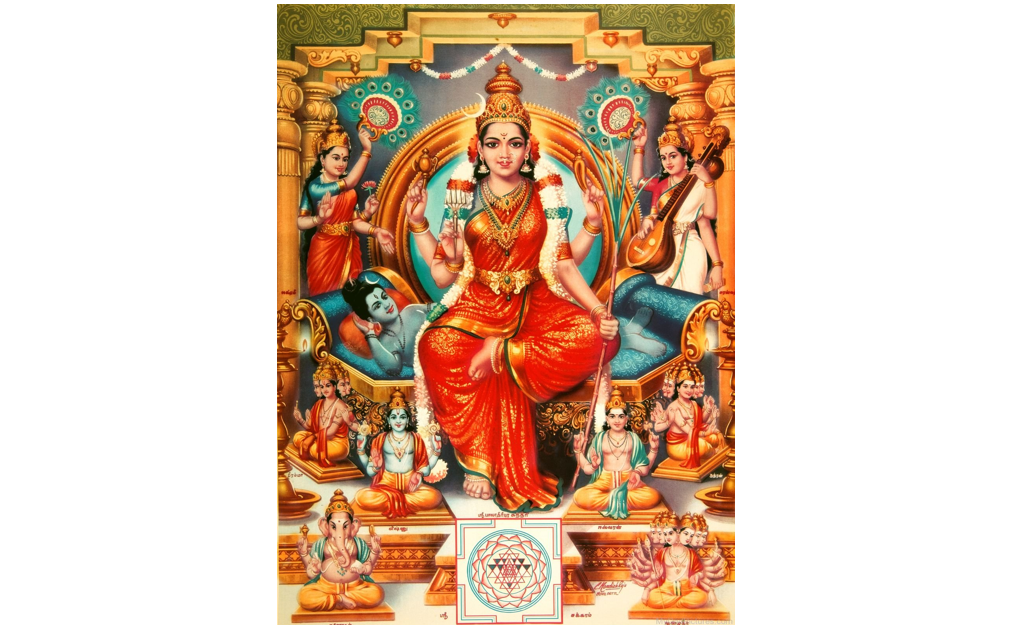
Saundarya Lahari is a compilation of 100 hymns that describe the physical and cosmic beauty of the goddess Lalitha or Tripura Sundari, who is counted among the 10 important Tantric goddesses called the Mahavidyas.
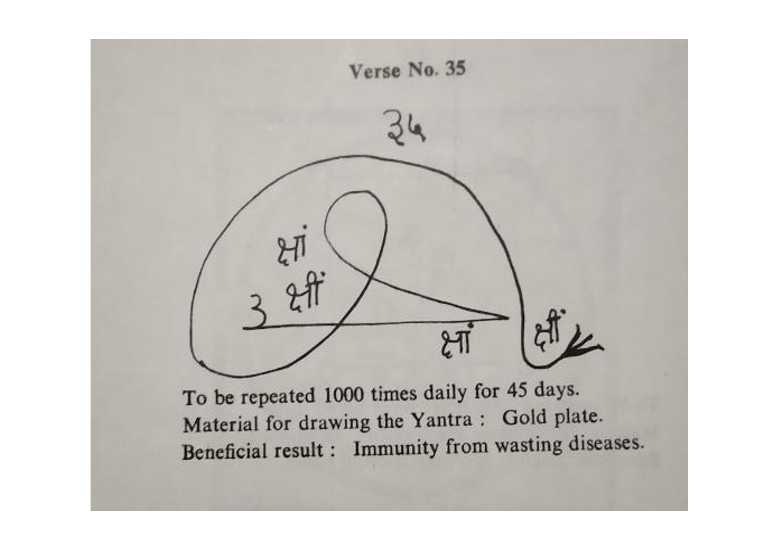
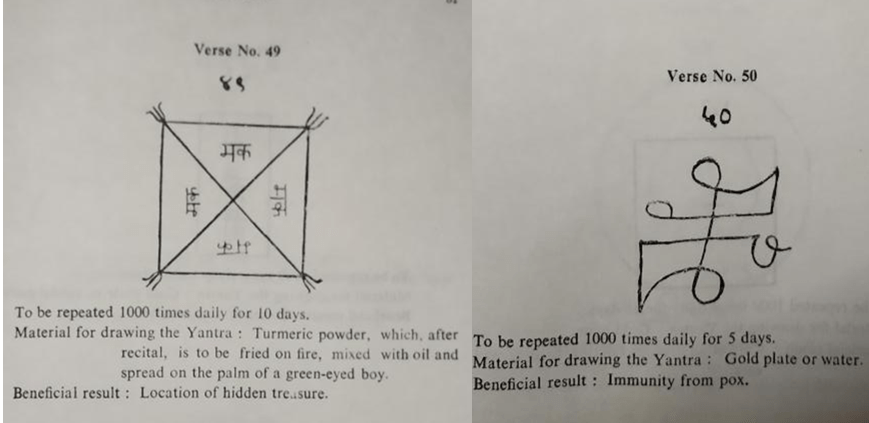
But Saundaryalahari is not merely a devotional text. It is also believed to be rich in tantric symbolism. Each of the hymns is associated with a yantra and a mantra. And the mantra when chanted a specific number of times, with the focus on the yantra, is believed to confer the practitioner with a specific benefit.
So, what is a yantra?
Yantra is a sacred diagram that can be understood as a visual representation of the mantra, which when chanted, conjures up the image of the deity being meditated upon. In other words, the yantra acts as a visual prop that helps the practitioner imagine the deity.
For example, if you want to mediate upon Lord Ganesha, you think of his elephant face, his trunk or his tusks or even the modaka in his hand. In the absence of such detailed iconography, a yantra is a useful tool that helps the practitioner concentrate on the object of devotion, the deity being invoked. The deity herself or himself resides in the mantra.
The practitioner can also energise the yantra by
instating the deity into the yantra, just as the idols in our temples are
energized through prana prathishta.
Each deity has a specific yantra ascribed to him or her. It’s only when the yantra is drawn on the specified material and the mantra is chanted the prescribed number of times over a specified number of days, the practitioner reaps the stipulated benefits.
While we are on yantra and mantra, here’s a fun fact. This relationship between form and sound has a scientific basis and qualifies as a field of study called Cymatics. Vibrations at varying frequencies interact with different materials on the vibrating mediums to create different patterns or forms. If this interests you, google for more!
Coming back to the yantras of the Soundarya Lahari, the diagrams range from very simple designs such as squares and rectangles to fairly complex figures. The material to be used for drawing these diagrams range from sandal paste to sacred ash to water and metals such as silver and copper although gold is most preferred.
The benefits promised for pursuing this sadhana or practice range from the ordinary such as improved fertility, multiplication of riches, control over armies, etc. to the exotic such as the power to enter other bodies, location of a hidden treasure, the power to hypnotise, etc.
However, there is one very important qualification for the sadhaka. And it is that he should be initiated into this practice only through his guru. Without proper initiation under the guidance of a qualified guru, the mantra or yantra cannot work.
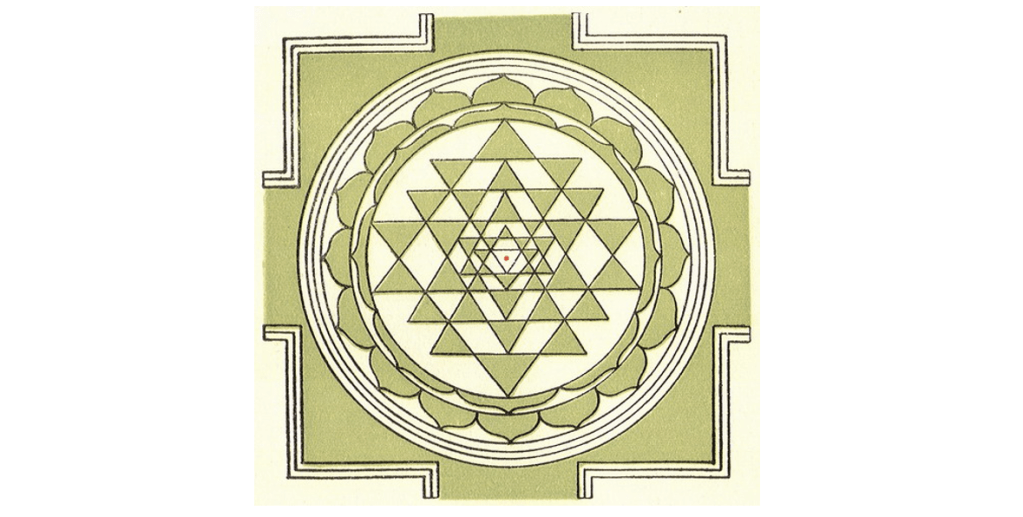
A yantra that is closely identified with Saundarya Lahari is the Sri Chakra. This yantra is described in detail in verse 11 of the composition, and is the yantra attached to verse 22. The Sri Chakra is considered as the goddess Lalitha or Tripura Sundari herself, and is believed to fully contain and express her.
The Sri Chakra comprises 9 interlocking triangles, four with the pointed apex facing upwards and five pointing downwards. The four upward pointing triangles represent the masculine force or Shiva, and the five downward facing triangles are considered to represent the feminine or Shakti. These nine triangles intersect to form 43 triangles organised in five concentric circles.
These intersecting triangles represent the union of the male and female forces that leads to creation. The sacred union is obtained in the centre of the innermost region of the interlocking triangles and this point is called the bindu, which marks the cosmic centre or the source of all creation.
The lotuses around the yantra
represent the reproductive vital forces, with each petal seating a female attendant or guardian deity
of
Shiva and Shakti.
Surrounding the lotuses are four openings that are likened to the gateways to
the universe.
This yantra is in fact considered by some to be the precursor to the design layout of our temples today!
Tantra is a vast subject and this was just an intro. Will delve deeper into the subject in my future blogs and videos.
References:
Soundaryalahari – V.K. Subramanian
Reflections on the Tantras – Sudhakar Chatotopadhyaya
History of the Tantric religion – N.N. Bhattacharya
The Ten Mahavidyas – Tantric Versions of the Divine Feminine – David Kinsley
For many Indians, Rama is god, and Ramayana is a holy text. Yet, there are some episodes in the epic that seem irreconcilable with the immaculate character of Rama, the most contentious being Sita’s agnipariksha.
Was Rama being unfair to Sita in urging her to take the trial by fire to prove her chastity?
Are we being fair to Rama when we try to judge him with our modern day yardstick?
How does Valmiki narrate this episode?
Do watch my video on Kulture Katha on whether the trial by fire was for Sita or, for Rama?!
Language, as they say, marks the pinnacle of human evolution. And humour & wordplay form the crown of that pinnacle. Being home to such evolved Indian languages such as Sanskrit and Tamil, India, not surprisingly, is the wonderful land of stories centered around wit and wordplay.
This video takes you through some of these stories, highlighting a unique wordplay episode from the life of the great Sanskrit poet Kalidasa and a story of uncanny humour involving the Tamil scholar Avvaiyar and her favourite deity, Murugan. There is also a cute little story about how even the gods could not put a word to the relationship between Ayyappan and Goddess Lakshmi!
Why is Krishna blue, is a question that we have all asked sometime in our childhood. It turns out that Krishna was not always blue.
Krishna, Indologists believe, may have been a pastoral deity, which explains why he is depicted with cows, donning peacock feathers and playing the flute, an instrument of the forest.
Krishna is also among the oldest deities known to us. So, his form and iconography have changed significantly over the centuries, when his skin colour changed from black to indigo to blue,
Check the journey of Krishna over the centuries and find out how he turned blue by playing the video!



 Kulture Katha