Mother goddess cult is deeply entrenched in Indian culture. Small groups and tribes that lay scattered all across India have had their own specific mother goddess worship traditions.
In what is known as the Sangam age (3rd century BCE to 3rd century CE), Kottravai was worshipped as the war goddess in the arid or desert landscapes of ancient Tamilagam (today’s Tamil Nadu).
Similarly, the origins of the war goddess Durga is traced to certain tribes that lived on the the hills of the Vindya mountains (hence, the deity is also referred to as Vindyavasini).
Over time, with the intermingling of the northern and southern cultures, Kottravai gradually began to be identified with Durga-Parvati.
This video discusses the various references to Kottravai that we find in ancient Tamil literature and through these references, traces the metamorphosis of Kottravai into Durga-Parvati.
The idea of a the dancing god is unique to Indian culture. And Nataraja is believed to be the king of dance.
This video explores the mythological, cosmic and spiritual symbolism hidden in the iconography of Nataraja. It also features two classical renderings of Shiva’s dance.
The great Indian epic, the Mahabharata, is full of riddles, puzzles and dilemmas. The epic poses several intriguing problems that make us wonder, who was right and who was wrong, who was good and who was bad…
But the one big question about the epic that baffles us no end is about Draupadi….
Why did she have five husbands?
Was Draupadi a victim of fraternal polyandry – a system where all the brothers in a family married the same woman to prevent land fragmentation?
Or was this Kunti’s idea to use Draupadi as the glue to keep her sons struck together?
Or, was poor Draupadi merely a pawn in the game fought by Pandavas and Kauravas for land?
Watch the video to know the answer to the trickiest riddle posed by the Mahabharata!
Shaktam or Shaktism is an Indian theological tradition where the cosmic energy that pervades the universe is perceived as feminine.
Adishankara’s compostion Soundaryalahari begins with a verse that says, only when Shiva is united with his Shakti, he is able to create; if he is not in union with her, he is not able to move or even stir. Indeed, it is said that Shiva without his powerhouse Shakti, becomes Shava or a corpse.
And when we talk of Shaktam, we cannot but talk about its esoteric sub-tradition, Tantra. But that is not to say Tantra Shastra or the Tantra knowledge system is confined only to goddess worship. Tantra, as a route to the divine, is also part of other Hindu traditions such as Shaurya or Sun worship, Ganapatya or the worship of Ganapati as also the Shaiva and Vaishnava traditions and even the Jaina and Buddhist faiths.
Now, tantra is a vast, deep and complex subject that calls for various levels of understanding at both the physical and metaphysical level. But if one were to hazard a highly simplified definition, it can be understood as a technique wherein the sadhaka or the practitioner uses the human body or the microcosm as the means to perceive the reality of the macrocosmic universe.
The Tantra practitioner identifies himself or parts of himself with the different dimensions of the cosmos through meditation techniques and the use of various rituals including hand gestures called mudras, images, mantras and sacred geometrical diagrams called yantras and mandalas.
Beyond just self-realisation, the practice of tantra can also be directed towards the realization of tangible gains. So, the aim of the practitioner can also be to identify himself with the goddess he or she is propitiating, and obtain what she possesses, be it her knowledge, or the powers to annihilate her enemies.
While tantra is esoteric knowledge that is often acquired and practised in secrecy, there is a text that brings Tantric ideas into the popular domain and makes it accessible to all. That text is Saundarya Lahari, a composition in Sanskrit, attributed to the great Adi Shankaracharya.
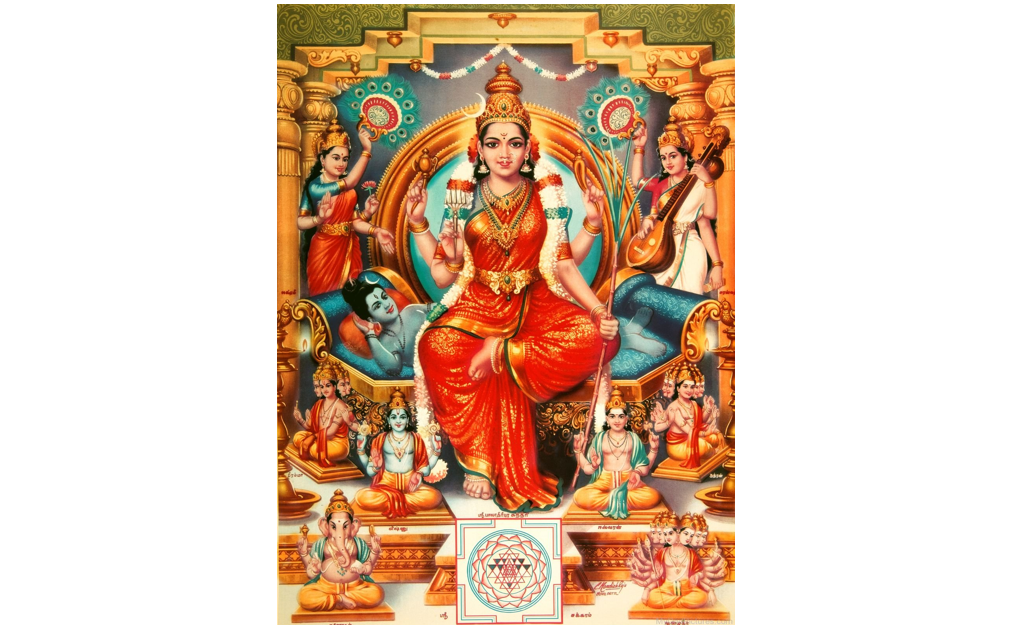
Saundarya Lahari is a compilation of 100 hymns that describe the physical and cosmic beauty of the goddess Lalitha or Tripura Sundari, who is counted among the 10 important Tantric goddesses called the Mahavidyas.
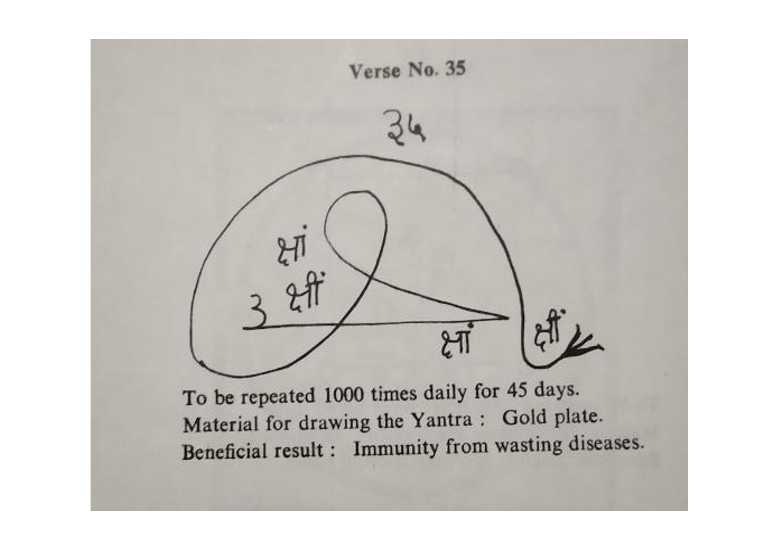
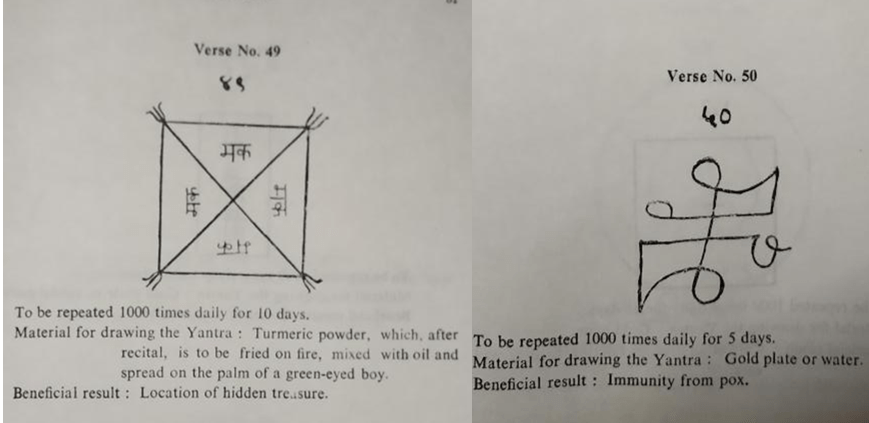
But Saundaryalahari is not merely a devotional text. It is also believed to be rich in tantric symbolism. Each of the hymns is associated with a yantra and a mantra. And the mantra when chanted a specific number of times, with the focus on the yantra, is believed to confer the practitioner with a specific benefit.
So, what is a yantra?
Yantra is a sacred diagram that can be understood as a visual representation of the mantra, which when chanted, conjures up the image of the deity being meditated upon. In other words, the yantra acts as a visual prop that helps the practitioner imagine the deity.
For example, if you want to mediate upon Lord Ganesha, you think of his elephant face, his trunk or his tusks or even the modaka in his hand. In the absence of such detailed iconography, a yantra is a useful tool that helps the practitioner concentrate on the object of devotion, the deity being invoked. The deity herself or himself resides in the mantra.
The practitioner can also energise the yantra by
instating the deity into the yantra, just as the idols in our temples are
energized through prana prathishta.
Each deity has a specific yantra ascribed to him or her. It’s only when the yantra is drawn on the specified material and the mantra is chanted the prescribed number of times over a specified number of days, the practitioner reaps the stipulated benefits.
While we are on yantra and mantra, here’s a fun fact. This relationship between form and sound has a scientific basis and qualifies as a field of study called Cymatics. Vibrations at varying frequencies interact with different materials on the vibrating mediums to create different patterns or forms. If this interests you, google for more!
Coming back to the yantras of the Soundarya Lahari, the diagrams range from very simple designs such as squares and rectangles to fairly complex figures. The material to be used for drawing these diagrams range from sandal paste to sacred ash to water and metals such as silver and copper although gold is most preferred.
The benefits promised for pursuing this sadhana or practice range from the ordinary such as improved fertility, multiplication of riches, control over armies, etc. to the exotic such as the power to enter other bodies, location of a hidden treasure, the power to hypnotise, etc.
However, there is one very important qualification for the sadhaka. And it is that he should be initiated into this practice only through his guru. Without proper initiation under the guidance of a qualified guru, the mantra or yantra cannot work.
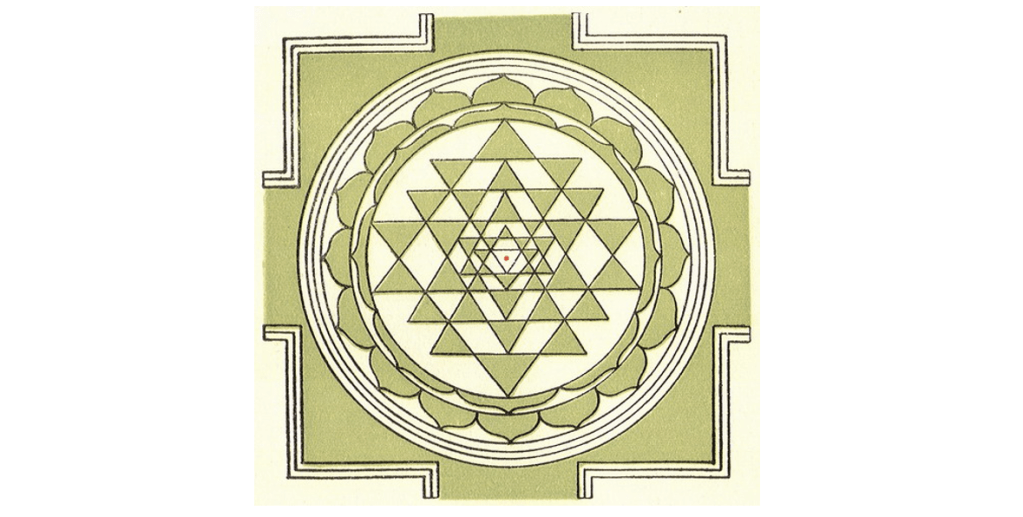
A yantra that is closely identified with Saundarya Lahari is the Sri Chakra. This yantra is described in detail in verse 11 of the composition, and is the yantra attached to verse 22. The Sri Chakra is considered as the goddess Lalitha or Tripura Sundari herself, and is believed to fully contain and express her.
The Sri Chakra comprises 9 interlocking triangles, four with the pointed apex facing upwards and five pointing downwards. The four upward pointing triangles represent the masculine force or Shiva, and the five downward facing triangles are considered to represent the feminine or Shakti. These nine triangles intersect to form 43 triangles organised in five concentric circles.
These intersecting triangles represent the union of the male and female forces that leads to creation. The sacred union is obtained in the centre of the innermost region of the interlocking triangles and this point is called the bindu, which marks the cosmic centre or the source of all creation.
The lotuses around the yantra
represent the reproductive vital forces, with each petal seating a female attendant or guardian deity
of
Shiva and Shakti.
Surrounding the lotuses are four openings that are likened to the gateways to
the universe.
This yantra is in fact considered by some to be the precursor to the design layout of our temples today!
Tantra is a vast subject and this was just an intro. Will delve deeper into the subject in my future blogs and videos.
References:
Soundaryalahari – V.K. Subramanian
Reflections on the Tantras – Sudhakar Chatotopadhyaya
History of the Tantric religion – N.N. Bhattacharya
The Ten Mahavidyas – Tantric Versions of the Divine Feminine – David Kinsley
For many Indians, Rama is god, and Ramayana is a holy text. Yet, there are some episodes in the epic that seem irreconcilable with the immaculate character of Rama, the most contentious being Sita’s agnipariksha.
Was Rama being unfair to Sita in urging her to take the trial by fire to prove her chastity?
Are we being fair to Rama when we try to judge him with our modern day yardstick?
How does Valmiki narrate this episode?
Do watch my video on Kulture Katha on whether the trial by fire was for Sita or, for Rama?!
Language, as they say, marks the pinnacle of human evolution. And humour & wordplay form the crown of that pinnacle. Being home to such evolved Indian languages such as Sanskrit and Tamil, India, not surprisingly, is the wonderful land of stories centered around wit and wordplay.
This video takes you through some of these stories, highlighting a unique wordplay episode from the life of the great Sanskrit poet Kalidasa and a story of uncanny humour involving the Tamil scholar Avvaiyar and her favourite deity, Murugan. There is also a cute little story about how even the gods could not put a word to the relationship between Ayyappan and Goddess Lakshmi!
Why is Krishna blue, is a question that we have all asked sometime in our childhood. It turns out that Krishna was not always blue.
Krishna, Indologists believe, may have been a pastoral deity, which explains why he is depicted with cows, donning peacock feathers and playing the flute, an instrument of the forest.
Krishna is also among the oldest deities known to us. So, his form and iconography have changed significantly over the centuries, when his skin colour changed from black to indigo to blue,
Check the journey of Krishna over the centuries and find out how he turned blue by playing the video!
Ganesha is a very old deity in the Hindu pantheon, a deity who has accumulated multiple attributes over time. Despite his popularity, there are many things that are puzzling about the deity. This video tries to explore answers some commonly asked questions about the god:
Why is Ganesha invoked first before we start anything new?
How did the puny little mouse become Ganesha’s vahana?
Why is Ganesha shown with a snake around his hips?
Why is Ganesha pot-belied?
Why is Ganesha depicted along with Lakshmi, the goddess of wealth?
Onam is typically celebrated for 10 days beginning the first day of the Malayalam month of Chingam. Onam is actually short for Thiruvonam, the nakshatra or the star associated with Vishnu.
In popular mythology, onam marks the annual return of Mahabali to pay a visit to his beloved subjects on earth from the underworld, where he was pushed into by Lord Vishnu.
According to the Bhagavata Purana, which narrates one version of the story, the asuras, led by King Mahabali, had conquered the three worlds, having driven out the devas from the heavens. Bali, the asura king then started to perform an ashwamedha yagna or a horse sacrifice to consolidate his sovereignity.
Meanwhile, Aditi,
Indra’s mother, who was upset over her son losing out to Mahabali, prayed to
Vishnu. Hearing her prayers, Vishnu took birth from her womb to help her son Indra
reclaim his position as the lord of the heavens.
Taking the form of a dwarf brahmin, Vishnu arrived at the horse sacrifice, where Mahabali was making generous donations to all the needy Brahmins. The story goes that the puny Vamana asked the king for land that could be measured in three paces of his foot.
Even when
warned by his guru Shukracharya that the dwarf was none other than Mahavishnu
in disguise, Mahabali decided to go ahead and grant the Brahmin’s wishes. But
once Mahabali agreed to gift him three paces of land, it is said Vamana the
dwarf grew into a giant of cosmic proportions and took gigantic strides to measure
the earth and the heavens with his two steps, asked Mahabali where he could
keep his third and last step. As there was no place left in the Universe for
Vishnu to measure his third pace of land, the defeated Mahabali surrendered by offering
the god his own head.
From this point, the story differs slightly across versions, of which there are many. According to one version, Vishnu kept his foot on Mahabali’s head and pushed him into the netherworld, which he was asked to rule thereafter. In another version, Vishnu does not push him into the netherworld, but rather asks him to reside and rule it and promises him that he would get to be Indra in another yuga.
The Bhagavatha Purana says that, despite being a virtuous king, Mahabali was punished because power and pursuit of material wealth had corrupted him and destroyed his humility. In his arrogance, he had even overlooked his guru’s advice to grant the Brahmin dwarf the gift he demanded, knowing very well the midget was none other than Lord Vishnu.
Now, many of you may be aware of the story.
But, how does the Mahabali-Vamana avatar myth actually connect to the onam festival?
Surprisingly, not all textual versions mention the request by Bali to visit his land and his favourite subjects every year. The bit about Mahabali coming up to the earth every year, appears rather to be a folk extension to a Puranic story.
And Onam,
that celebrates the return of Bali to the earth, is essentially a folk festival
that celebrates the completion of paddy harvest. On this occasion, the just and
egalitarian rule of Bali is remembered in the Malayalam folk songs that are
sung to welcome the king.
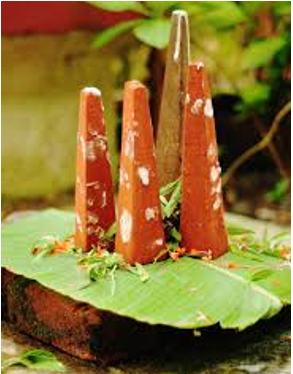
Apart from the performance of folk arts and sports such as the kathakali and the famous boat race, other folk motifs include the use of pyramid-shaped four-sided blocks made of clay called Onathappan, that are used to symbolically represent a local deity named Thrikkakara appan or Vamana Vishnu. According to some, these pyramidical clay blocks represent Mahabali or Maveli as he is fondly referred to by the locals. This an-iconic representation of the gods definitely points to very ancient folk customs.
Interestingly, the celebration of bali is not restricted to Kerala. King Bali is remembered and hailed in several parts of western and southern India on the fourth day of Diwali as Balipadyami or Balipratipada, marking the end of the summer harvest. In fact, the farmers of Maharashtra pray every year for the return of the fair and just rule of King Bali.
So, in a sense, the annual return of Bali to earth, from the nether land seems to suggest a symbolic association with the fecundity of the land that is renewed every year after the monsoons, when the Onam festival falls.
How modern narratives interpret the myth…
In modern narratives, the mass popularity of the legendary Asura king punished rather unduly by Vamana Vishnu, has led the story to be interpreted as a conflict between two different cultures, where an Aryan tribe, represented by their god, established supremacy over Bali, the just and fair king of a non-Aryan tribe.
This version is in sync with other subaltern narratives where the Asuras have been understood to be the oppressed class with the Devas being envisioned as the upper caste oppressors.
Moreover, the vamana story, also comes across as a sort of a prequel to the story of Parashurama, another avatar of Vishnu, who, despite being a Brahmin, took to arms to end the tyranny of the Kshatriyas or the ruling class. According to a legend that links both these stories, the entire western coast of India, is believed to have been retrieved from the sea by Parashurama with his axe, to relocate the Brahmin community. And Onam celebrates the creation of Kerala by the sage.
In this myth, the relocation of Brahmins by Parashurama could have involved the displacement of the existing residents of the Western coast, probably pushing them south. The movement of people further down (south) is possibly reflected in the story of Bali who is pushed down (into the earth) by a Brahmin.
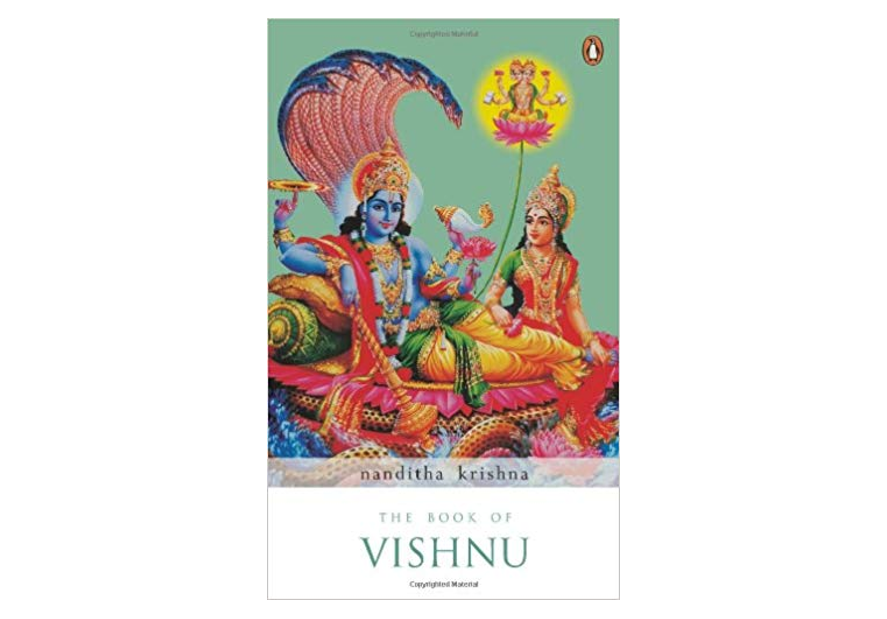
While these stories do seem to hint at conflicts over land leading to possible displacement of some groups of people, author Nandita Krishnan, in her work, Book of Vishnu has proposed a completely different interpretation of the myth.
She points
out that the vamana avatar story has its seed in the RigVeda and the Shatapatha
Brahmana, a Vedic ritual text. In these texts, Vishnu was considered an aspect
of the Sun and counted among the 12 adityas or solar deities.
The sun takes
three strides across the sky through the day – appearing at the horizon at
sunrise, touching the zenith at noon and disappearing below the horizon at
sunset. Similarly Vishnu in his Vamana avatar has been shown to take three strides
across the universe, covering the earth, heavens and the underworld.
Nandita suggests that Onam celebration is a symbolic representation of the harvest which is welcomed with a thanksgiving offering ‘bali’, after the passage of a hot summer as depicted by the solar deity, Vishnu. So, just like Pongal or Baisakhi, Onam marks the celebration of the harvest, which was made possible by the Sun, to whom mahabali or a great offering is made.


 Kulture Katha