Astronomy essentially started off as a system of time-keeping. Ancient man used the cyclical movements of the large celestial bodies he observed in the skies to develop his system of time-keeping. Through his observations, he evolved the systems of a 7-day week, a 30-day month, a 12-month year and so on. But how did he arrive at these numbers, 7, 12, 30 and so on? This blogpost is an attempt to answer two key questions relating to numbers in Indian Jyotisha.
In Vedic astrology, each day of the week is referred to as a vara. The word Vara means ‘a turn’, from which incidentally comes the Hindi word baari, which also means turn. Here, the word vaara refers to the turn of a planet to rule a day.
Now, the seven distinct celestial bodies known to ancient man were the sun, the moon and the five planets including Jupiter, Saturn, Venus, Mars and Mercury. Although the visible sky is littered with several smaller, shining stars, these 7 large luminary bodies are the ones visible to the naked eye from the earth.
So each day or vara that lasted from one sun rise to another came to be dedicated to each of these 7 celestial bodies. That’s how we have somavara or Monday dedicated to the moon, the Mangalvara or Tuesday dedicated to Mars, Budhavara to Mercury and so on.
Although we share this idea of a seven-day week with Hellenistic or Greek astrology, not all cultures seem to have had a 7-day week. For example, ancient Chinese and Egyptian calendars had a 10day week whereas traditional Korean and Javenese calendars had a 5-day week.
But the real reason why the Indian system has a 7-day week is the moon. Yes! Remember the moon’s journey around the earth is the reason which led to the concept of months.
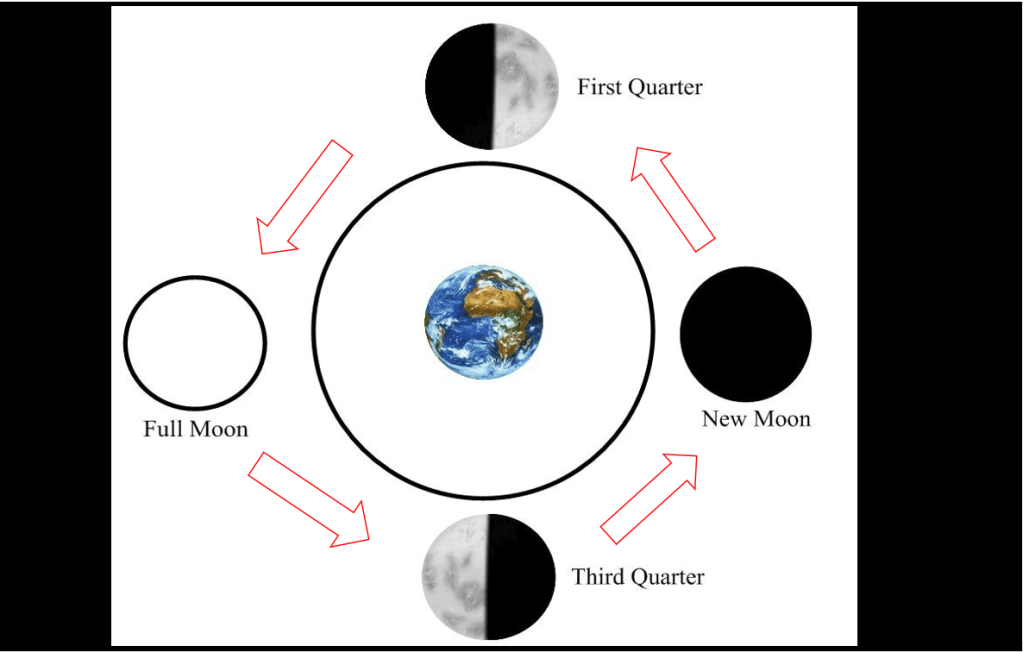
The moon’s phases or pakshas can be broadly classified into four quarters. The first quarter is the phase from the new moon to the half-way phase of the waxing moon, the second quarter is the phase from the half-moon to the full moon or purnima. Then comes the third quarter from the full moon to the half-way phase of the waning moon and the final phase from the half-moon to the new moon or amavasya.
Four phases of the Moon
The time taken for a moon to go through these four phases is what we call a synodic month that lasts 29.5 days. But the time that the moon takes to complete a revolution around the earth is about 27.3 days. This system of accounting for the moon’s movement vis-à-vis certain fixed stars in the sky is called the sidereal system.
The average of the synodic and sidereal months works out to roughly 28 days. When these 28 days are divided across the four quarters of the moon’s phases that we talked about a while back, we get 7 days per quadrant. Each quarter thus becomes a week, made up of 7 days.
Kalidasa’s great epic Kumara Sambhava opens with a salutation to Shiva and Parvati where he refers to them as the parents of the world who are as inseparable as a word and its meaning.
In Indian thought, the title of mother is not just restricted to Parvati but to all our goddesses. They tend to their devotees as a mother tends to her child.
Here’s a sthalapurana of a temple from deep down south, where the goddess rushed to the help of her devout son when he needed her most.
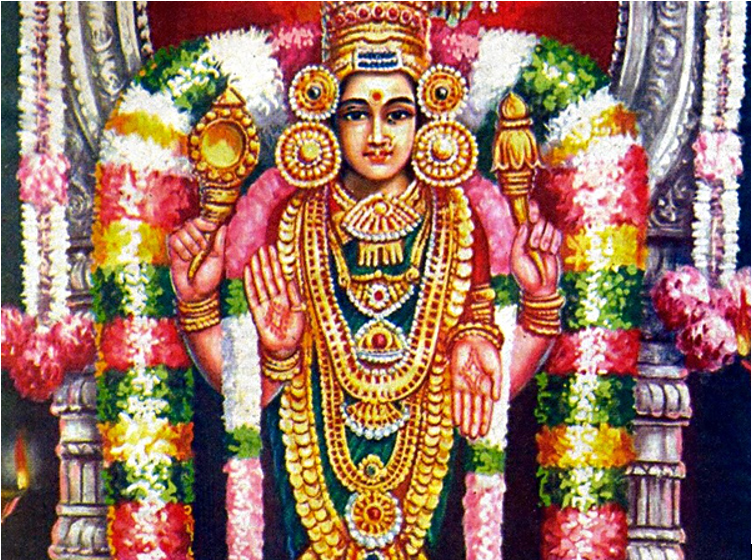
So the story goes that sometime in the 18th century AD, there lived a Brahmin named Subramanyam Iyer in a small town called Thirukadaiyur in Tamil Nadu. His town had a famous Shiva temple where the presiding deity was Lord Amrithaghateswar and his consort was Goddess Abhirami.
Subramanyam was a regular visitor to the temple. He was deeply devoted to Goddess Abhirami. So intense was his faith that he saw the goddess in every woman and much to the discomfort and annoyance of the women in his town, he chased them around and showered them with flowers before prostrating at their feet. This quirky behaviour of his earned him the title of a lunatic.
On one new moon day, the local king Sarfoji, came to the temple for a darshan of the goddess. At the sanctum sanctorum of the temple, he found Subramanyam deep in meditation. Now, the king was used to having people rushing to his beck and call. So, Subramanyam’s complete oblivion to his presence angered him. Sarfoji enquired the locals about Subramanyam and was told that Subramanayam was a mad man.
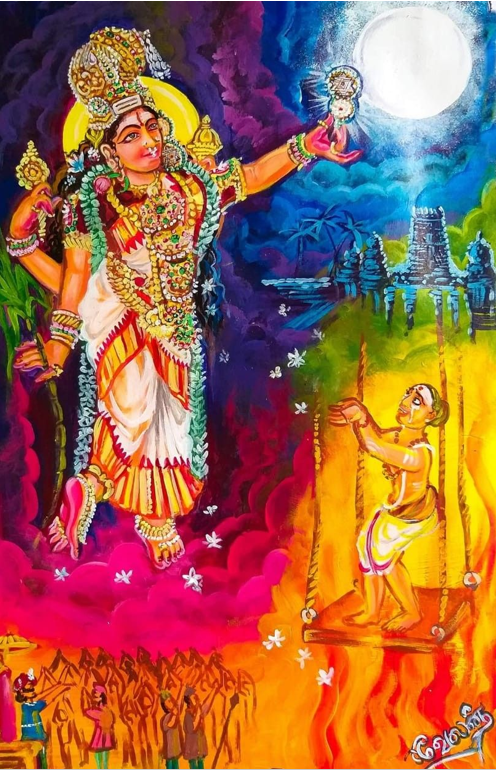
The king decided to run a test of his own on the man sitting before him. He nudged the meditating Subramanyam and asked him if he knew what day of the lunar month (thithi) it was. Now, everyone knew it was the new moon day (Amavasya), when the night sky would be moon-less and dark. But Subramanyam, whose eyes were fixed on the face of the goddess that looked as bright as the glow of a thousand moons, blurted out that it was a full moon day (Purinma).
Angered by the wrong answer, the king ordered that Subramanyam be punished. As per the king’s order, Subramanyam was to be suspended on a wooden deck hung over a blazing fire with the help of ropes. The deck hosting Subramanyam was to be purged into the fireplace below, at dusk, if the moon did not rise, as he had predicted.
But, as happens with all men of god, Subramanyam remained unperturbed! It is said that, it was while hovering over the blazing fire that Subramanyam composed and rendered over a 100 hymns in praise of Goddess Abhirami.
After each hymn was rendered, the deck was lowered further. The onlookers waited with bated breath to see what would happen!
Legend has it that just as Subramanyam finished rendering his seventy-ninth hymn, Goddess Abhirami appeared before him, removed her resplendent earring and threw it at the sky where it shone like the silvery moon!
Subramanyam’s words had indeed come true!
On a supposedly no-moon night, there was now a round silvery moon that shone like a brilliant jewel, turning an otherwise dark night sky into a brightly lit celestial canvas.
The king, who witnessed this miracle, realised the extreme devotion of Subramanya Iyer, sought his forgiveness, and set him free.
From that day, Subramanyam came to be known as Abhirami Bhattar. The hymns he composed are known as Abhirami Andhadhi, an exquisite piece of devotional poetry, where every verse starts with the same word that the previous verse ends in.
Abhirami Andhadhi is still read and rendered by millions of Tamils even today. It is believed that rendering these hymns on full moon and new moon days can make the great mother grant the most impossible of her children’s dreams!
Akshaya Tritiya, as you many of you may know, falls in the month of Vaishaka on the third day after amavasya i.e. in the phase of the growing or waxing moon.
Over the last couple of decades, Akshaya Tritiya, has come to be associated with the purchase of gold or some consumer durables for the house or investments in properties.
But was this day always about accumulating wealth and riches? Maybe not!
The name of this auspicious day itself probably holds a clue. Akshaya means perpetual or undiminishing, that which does not become less. And Tritiya refers to the third lunar day that falls either after the new moon or amavasya or after the full moon or the Purnima.
But what significance does the tritiya tithi have?
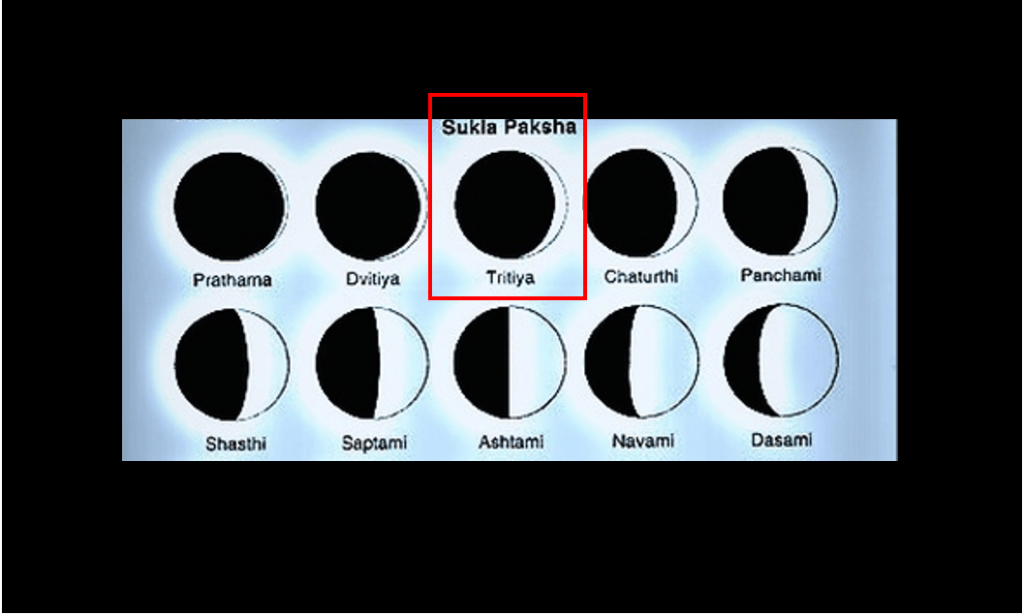
On pratama tithi of the growing moon, or the day that follows Amavasya, the moon is not visible to us. On Dwitiya tithi or the second day after Amavasya, the moon is visible as a slender sliver for a very short time in the sky, making it difficult to spot it. The tritiya tithi, or the third day after the Amavasya is when the moon can be spotted easily and it remains visible in the sky for a fairly long period of time.
Tritiya Tithi in the Waxing or Growing phase of the Moon
So it is really on the tritiya tithi that the moon starts to display its steady phase of growth. From this day, one can see the moon grow and grow till the Purnima tithi or the day of the full moon. The growing moon phase was always considered auspicious which explains why our festivals fall in this Shukla paksha, the phase of the growing moon and very rarely in Krishna paksha or the phase of the waning moon.
Tritiya tithi is thus believed to have the ability to bestow strength and is hence referred to as ‘bala prada’.
But Tritiya tithi of the Shukla paksha or the growing moon phase occurs once every month. So, what makes Akshaya Tritiya special?
For that we need to look at other astrological aspects of this day.
To get there, first we need to understand the concept of the tropical zodiac.
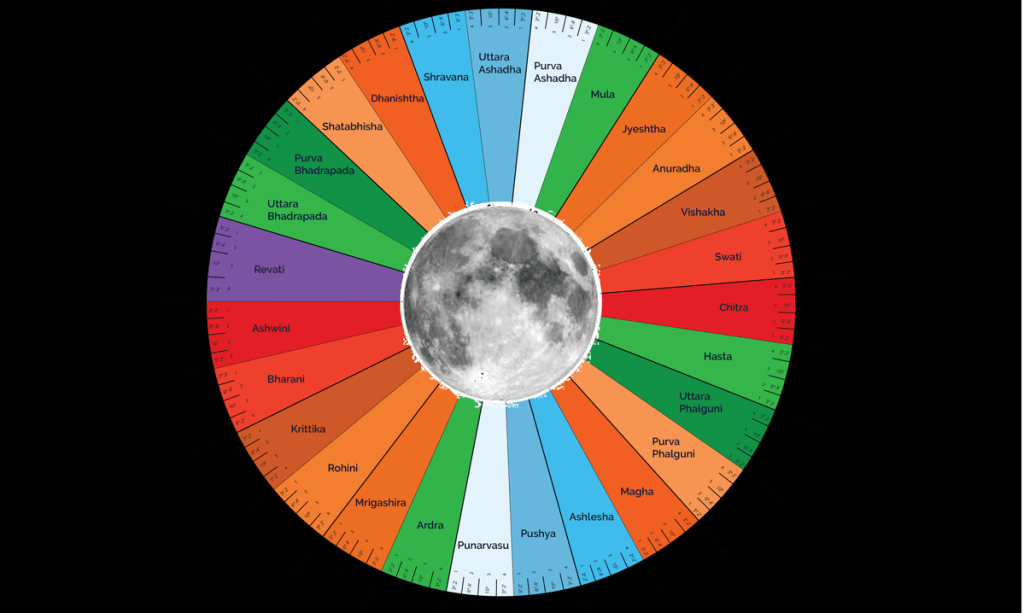
You may remember what I had shared on Nakshatra in my last blog post. To recapitulate, Nakshatras are basically segments of star constellations that fall in the moon’s orbit around the earth. The constellations through which the moon is seen to transit have been divided into 27 segments, each of which is denoted by a prominent star in that constellation.
The Nakshtatras or the Sidereal Zodiac
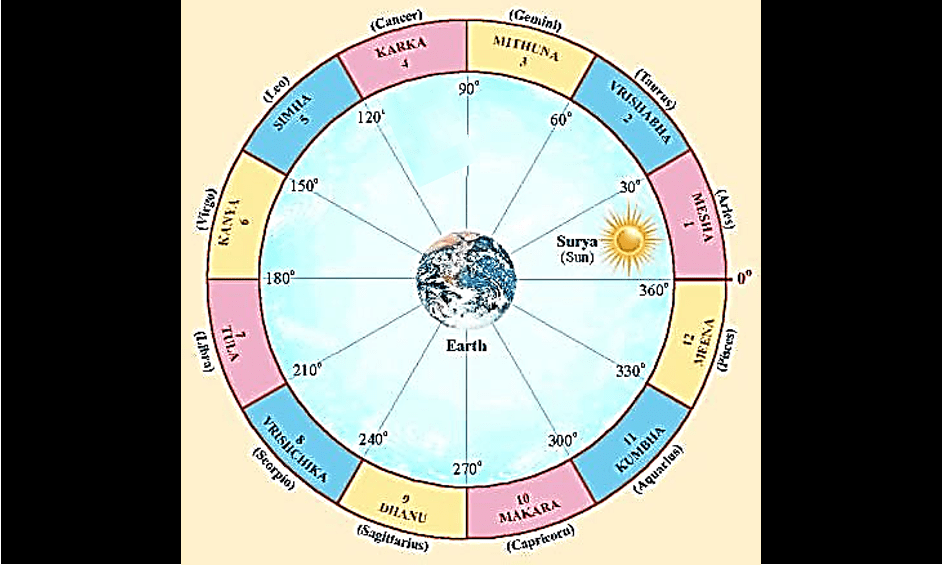
Similarly, the sun’s orbit, as seen from the earth, is divided into 12 segments called the tropical Zodiac or the Rashis. The Sun’s transit through each of these 12 segments makes up for a month in the solar calendar.
The Rashis or the Tropical Zodiac
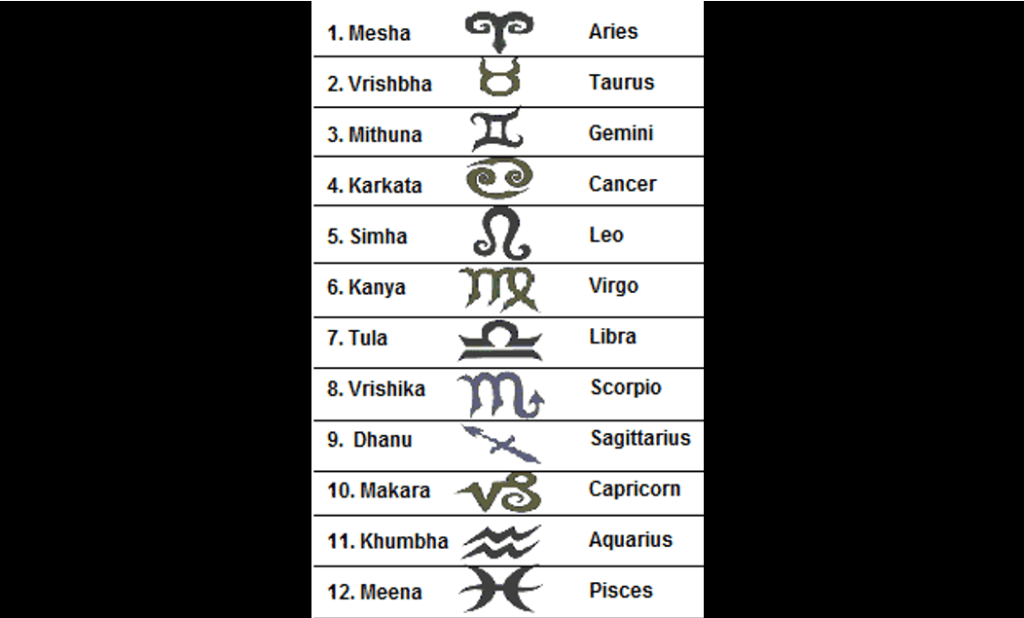
Each of these 12 Rashis is denoted by a name such as Mesha or Aries, Rishabha or Taurus, Mithuna or Gemini, Kataka or Cancer and so on in that order.
Names of the Rashis
Now, what makes Akshaya Tritiya more special is that the positions of the sun and the moon in these zodiacs are the best positions they can ever be in. Let me explain.
We all know there are nine planets or grahas in Indian astrology. All these nine planets or grahas are believed to have heightened powers when they are in a particular zodiac. The zodiac where a celestial body’s powers are heightened is called its position of exaltation.
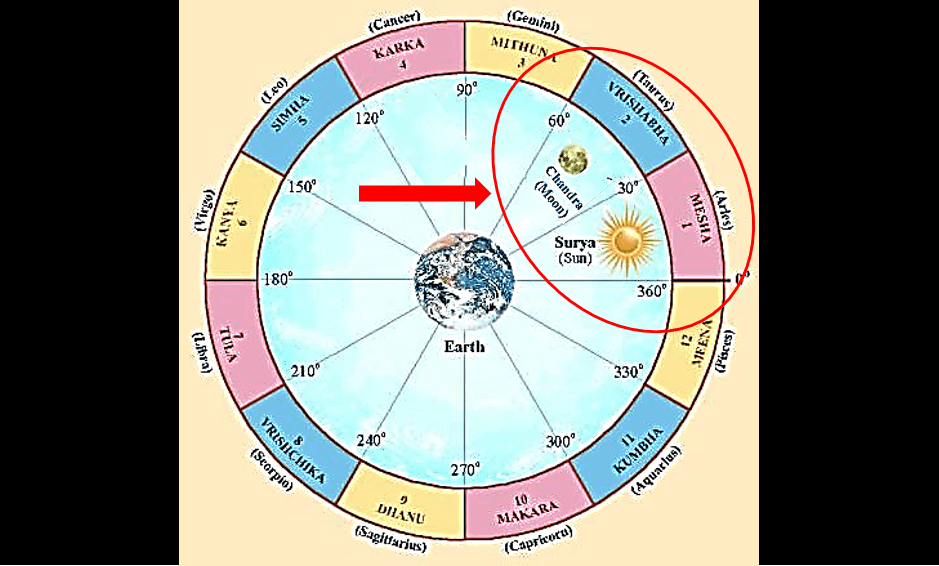
The Sun is exalted in the zodiac of Mesha or Aries, which marks the onset of summer, the period from which the sun’s intensity is set to continuously increase. At the same time, the moon is also exalted in the zodiac of the Rishabha or Taurus.
Both the Sun and the Moon on adjacent zodiacs in exalted positions
And it is this combination of exaltation of both the sun and the moon achieved on the Tritiya tithi of the month of Vaishaka, which makes the day especially auspicious. For this reason, it is one of those rare days in a year when every second of the day is considered auspicious, which makes it a full ‘muhurat’ day.
Of course, as with many of our festivals, Akshaya Tritiya too is related to the crop cycle. In Odisha for instance, farmers start cultivation of their lands on this day. It is also the day when work starts on the construction of the chariot for Puri Jagannath’s Rath Yatra. In some other regions, this day is considered appropriate to donate money and give away charity. Some people observe fasts on this day. Of course, it was also considered a good day to start new ventures and buy valuables.
And it is this last aspect that the gold vendors in our country have capitalised well and made a fortune for themselves!
But for the astronomers and astrologers of ancient India, this day was considered an astrologically significant event when the first signs of the growing visible moon of Vaiskaha was seen in Taurus, the zodiac of its exhaltation, along with an exalted Sun in Aries.
And this celestial phenomenon is what made Askhaya Tritiya special for them!
Buddhism, as we all know, had its birth in India and emerged as an extremely popular religion across Asia in the first few centuries after Christ.
Buddhism rose as a faith that challenged the then prevailing Vedic religion. The Buddha is believed to have condemned several Vedic sacrifices and rituals that were practised in the regions of the Indian subcontinent (modern day Nepal and Bihar) where he lived and preached. More importantly, he rejected the Vedas and evolved his own universal philosophy. Not surprisingly, Buddha and his followers were censured severely as a heretic in several Vedic texts and scriptures.
Isn’t it strange then that the same Buddha, who challenged Hindu practices, was later absorbed into Hinduism as an avatar of Vishnu?
Buddha as an avatar of Vishnu at Dwaraka Tirumala temple, Andhra Pradesh
Research scholars offer various theories on us how and why it could have happened.
But before we get there, it is important to understand that neither the term Hinduism nor the Hindu way of life practised today, existed during the times of Buddha. The Hinduism that we practise today is the result of a long period of transition marked by the amalgamation of several religious and folk ideas, and influences of various traditions, practices and faiths including Buddhism.
I use the term ‘Hinduism’ here, to refer to the religion as it is understood today. On the other hand, the term ‘Buddhism’ here does not refer to the modern-day Buddhism or neo-Buddhismpractised in India today.
How Buddha become a Hindu god
It so happened that when the great emperor Ashoka embraced Buddhism in the 3rd century BC, Buddhism attained the status of the imperial religion and Buddha became its godhead.
Buddhist cannons were carved on rocks across the empire for the people to read and follow. This made Buddha central to Ashoka’s kingship. As Ashoka’s name (as found on his edicts) ‘Devanamapiya Piyadasi’ indicates, Ashoka wished to identify himself as the ‘Beloved of the Gods’, and that god was Buddha!
Or, in other words, Ashoka came to rule in the name of Buddha. Buddha’s ‘Dhamma’ became the royal diktat and his ‘Dhammachakra’ became part of the royal insignia. And, Buddhism became the dominant religion in Ashoka’s empire.
In the centuries that followed, Ashoka’s idea of ‘god-king’ gained huge popularity among Indian kings. With the emergence of Vaishnavism as a major religion around the 4-6th century AD under the Guptas who ruled large parts of northern India, Vishnu started to gradually replace Buddha as the godhead. In fact, many Gupta kings called themselves ‘Bhagavata Vaishnavas’.
But Buddhism was still a significant force to be reckoned with for the constantly evolving Hinduism that had its roots in the Vedic religion. Buddha could not be just cast away!
What probably happened thereafter is best expressed using the popular adage, “if you can’t beat them, join them!”
Buddha began to be gradually assimilated into the Hindu pantheon, and by the 13th century AD, when Buddhism had all but died out in India, Buddha’s assimilation into the Hindu pantheon as an avatar of Vishnu was complete!
Proof of Buddha’s entry into the Hindu pantheon can be found in various Puranas that were composed during the period from 3rd -13th century AD, of which at least four puranas mention Buddha as an avatar of Vishnu. Apart from textual references, we also find Buddha counted among the Dashavatars in the relief works of the famous Srirangam and Airavatesvara temples of Tamil Nadu and the Channakesava temple of Karnataka, to name a few.
Buddha as an avatar of Vishnu in the Channakesava temple, Somanathapura, Karnataka
Although textual and epigraphic evidences suggest that Buddha was included into the Vaishnava pantheon, it appears doubtful if he was accepted on par with the other avatars. For example, according to Vishnu Purana, Buddha was actually born to mislead the asuras and steer them away from the truth (through his teachings?)! Whereas, some Dashavatara lists exclude Buddha, and include Balarama instead.
Buddha as an avatar of Vishnu in a Persian painting
But this is not to say that Buddhist ideas were rejected in toto by the Hindus. There was significant exchange of ideas between the two opposing faiths. In fact, it is argued by some that the Upanishadic thoughts, especially relating to Advaita Vedanta, have borrowed several ideas from Buddhism.
This process of gradual assimilation of Buddhist ideas into Hinduism reached the point of culmination with Buddha being accepted as a Hindu god.
But, why an avatar of Vishnu?
The answer to the question why Buddha came to be identified with Vishnu and not any other deity can be found in Vaishnava theology and mythology.
The Vaishnaivites perceive Vishnu as an all-pervading transcendental phenomenon, similar to the Upanishadic idea of an all-encompassing ‘Brahman’. But the transcendental, immeasurable Vishnu becomes accessible to man when he descends to the earth in various forms or incarnations called avataras.
This idea of Vishnu taking various forms (to fight evil) enabled the process of assimilation of various indigenous deities and cults into the Vaishnava fold, including the Buddha.
Stunning similarities between Vaishnavism and Buddhism
Apart from the basic structure of Vaishnavism that facilitated Buddha’s entry into its fold, the stunning similarities we find in their mythology and iconography also probably assisted the process of assimilation.
For example, an idea comparable to the Vaishnava belief that when evil ascends, Vishnu descends to the earth in order to re-establish ‘Dharma’ can be found in Buddhist scriptures and theology too.
Also, in Buddhist mythology, we find a story that is strikingly similar to the Vamana/Trivikrama avatar of Vishnu, where ‘Buddha covers 6,800,000 yojanas in three strides from the earth to the Devaloka’.
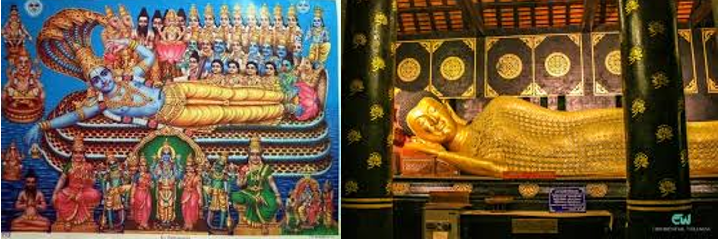
Ananthashayana Vishnu and the Reclining Buddha
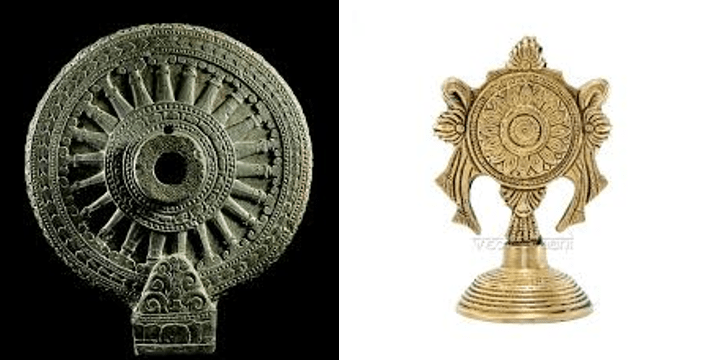
Not to forget, the uncanny resemblance in the iconography of Buddha and Vishnu – be it in Buddha’s Dharmachakra and Vishnu’s Sudarshana Chakra or in the posture of the Ananthashayana Vishnu and the Sleeping Buddha.
Buddha’s Dharmachakra and Vishnu’s Sudarshanachakra
The story of Buddhism in India is, in some ways, also the story of the all-embracing Hinduism. The inclusive nature of Hinduism and its tolerance and acceptance of diverse (and often, opposing) ideas and ideologies is the reason why it continues to survive and flourish as the world’s most ancient way of life!
Key resource:The Buddhist Vishnu: Religious Transformation, Politics and Culture – John C Holt
Indian mythology is replete with stories where wives and lady loves undertake extraordinary journeys to save their beloveds from tricky tribulations and sticky situations, at times even bringing them back from the dead. The stories of Satyavan-Savitri, Nala-Damayanti, Arjuna-Ulupi show how women moved heaven and earth for the sake of the men they loved.
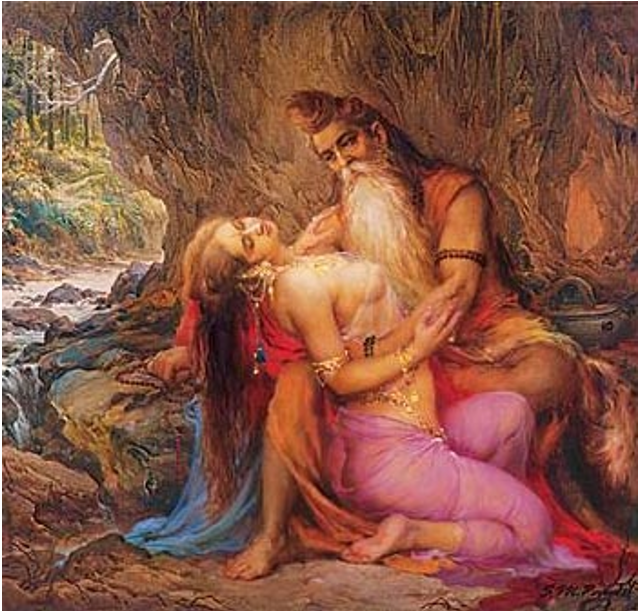
But, it’s not often that one finds stories of a husband or lover who is willing to walk the extra mile for the sake of his lady love or wife. In that sense, the story of Ruru and Pramadvara that finds mention in the Adi Parva (Pouloma sub-parvan) of the Mahabharata is unique for it illustrates that a man too is capable of as much love as a woman.
Ruru was born in the illustrious line of Sage Bhrigu. He was the son of Pramati, who was the grandson of Sage Bhrigu.
When Ruru was a grown man, one day he happened to see Pramadvara, the beautiful damsel born to the Apsara, Menaka and Vishvavasu, the king of the Gandharvas. Immediately after her birth, Pramadvara had been abandoned by Menaka on a river bank. A sage named Sthulakesha had found the girl child and had brought her up as his own. With time, Pramadvara had blossomed into a beautiful woman.
So, when Ruru first set his eyes on Menaka’s daughter, he was smitten. Soon, with the blessings of his father- Pramati. and Pramadvara’s foster father- Sthulakesha, Ruru and Pramadvara were engaged to be married. A wedding date was fixed and, the young couple started to look forward to their marital union.
However, it turned out that cruel destiny had different plans for them.
One day, when Pramadvara was playing with her friends in the forest, a venomous snake sunk it fangs into the body of the girl. As soon as she was bitten, Pramdvara fell down senseless on the ground. On hearing the news, Ruru rushed to see his beloved and was overwhelmed with grief to see the beautiful Pramadvara lying dead on the ground.
Unable to bear the sight of his dead lady love, Ruru wept loudly. He cried out loud saying if indeed he had remained true to his austerities as a Brahmin, had performed the prescribed rites, respected the elders and had selflessly given away alms, then his dear Pramadvara would have to rise from the dead.
On hearing Ruru’s lamentations, the messenger of the gods responded saying that no amount of bemoaning by Ruru could help Pramadvara, for once the mortal life of a person was over, there were no means of reviving them.
However, the messenger offered a consolation….there was one way by which Pramadvara could be brought back to life. If Ruru was ready to give up half of his life for Pramadvara, she could be brought back from the land of the dead. Hearing this, Ruru was overcome with joy. He readily agreed to give up half of his long life span for his dear, beloved Pramadvara.
At once, the permission of Yama – the lord of death was sought. Yama consented to allow Ruru to revive Pramadvara. Immediately thereafter, Pramadvara arose from the dead, lovely as ever, filling the grieving Ruru’s heart with untold joy. The lover couple was ecstatic to be back together again.
Ruru and Pramadvara were married shortly thereafter, and the couple spent many a wonderful year rejoicing in each other’s company.
Thus, Ruru stands tall among men, who are capable of as much love as a woman, and can even make the ultimate sacrifice of partaking their lives with their lady loves.
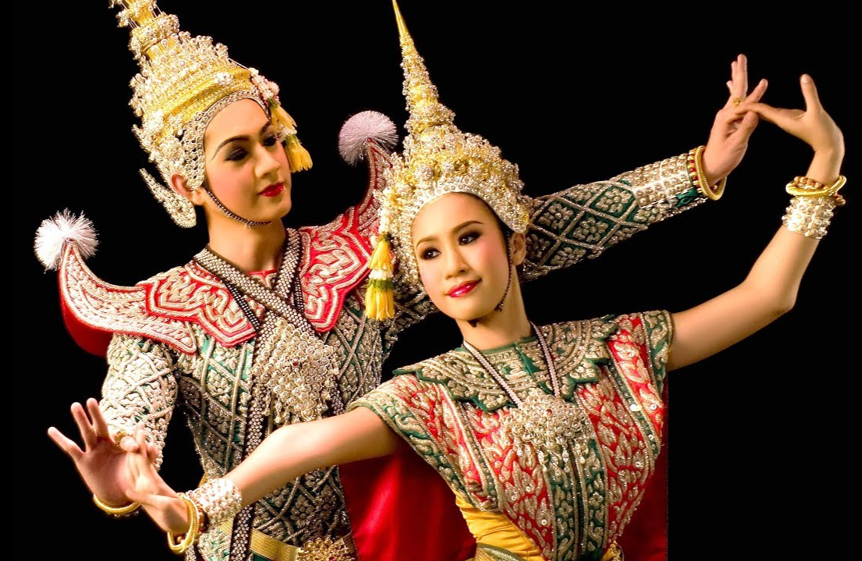
Performance of Ramayana in Khon, a Thai traditional dance
How the epic spread beyond the Indian subcontinent
After diffusing widely and deeply into the Indian subcontinent, the story of Rama slowly and surely started to seep overseas.
With the spread of Buddhism and the colonization of several lands in the Indian ocean by Indian kings, the story of Rama entered the South East Asian kingdoms.
Late professor and Sanskrit scholar Dr. V Raghavan once pointed out that the epic’s popularity in the predominantly ‘Buddhist’ South East Asia can be attributed to its seamless integration into Buddhist writings where Rama was depicted as a Boddhisatva. The Dasharatha Jataka, the Buddhist retelling of the epic, leveraged on the persona of Rama to propagate Dhamma.
Just as Tulsi’s idea of Ramarajya led to the establishment of Rama as the archetypal king for the Indian ruling class, in Thailand, the monarch takes on the title of Rama and rules in his name. In certain Sanskrit inscriptions from Champa (in today’s Southern Vietnam) and Cambodia, we find the local king being compared to Rama.
But Rama was not always the protagonist in these stories…
But this is not to say Rama, was the protagonist in all the versions of the epic. In several versions, the heroic role of vanquishing Ravana was often handed over to Lakshmana, who was perceived to be the more macho of the two. The values that Rama stood for in India (Maryada purushottam and eka patnivrata) were not necessarily endorsed or cherished by every society. In several south Asian versions of the epic, Rama’s commitment and fidelity to Sita is not upheld as a desirable trait and was looked upon as an oddity and often discounted. However, these variations, sometimes small and sometimes significant, enabled the epic to cut across cultural barriers and find root in diverse societies having different value systems.
What makes Ramayana a timeless classic?
Whatever be the composer’s raison d’être for the epic, the popularity and timelessness of this evergreen epic can be pinned down to a single notion – its unequivocal endorsement of the family system. For the society at large, the story of Rama is one of domestic relationships, of familial obligations, fraternal bonds and romantic love.
Indian women, for instance, identify with the character of Sita, and the sufferings she underwent, which finds reflection in the Telugu folk song tradition and in the Madhubhani paintings of Bihar. Sita bidai, the departure of Sita for her in-laws’ house, is a common theme in the Madhubani paintings tradition carried on by the women of Mithila, believed to be Sita’s birthplace.
Thus, in the folk art and tribal adaptations of the epic, we often find that the focus is on domestic relationships, and esoteric contemplation on dharma are absent.
Individual ambitions and aspirations have never mattered much in the Indian context. On the contrary, obedience and conformity to a clan’s social structure is encouraged. That is why Ravana’s lust for a woman was punished. Ravana’s was an individual’s aspiration for which he compromised the interests of his clan. Whereas, Rama, even as a manifestation of the divine, did not act for himself, but as a torchbearer for his dynasty and the values it stood for. It is this idea of the superiority of the clan over the individual, endorsed by the epic that continues to resonate deeply with the common man even today.
Ramayana – story or history?
The question whether Rama existed or not is one we endlessly debate. Maybe Rama did exist, and his incredible life story gained the proportions of a magnum opus with time. Or maybe, he didn’t, and was but an embodiment of an ideal man, a society’s idea of a perfect monarch. Either way, the answer does not matter. Historic figures rarely reach the zenith of adulation that mythological heroes do. As the hero of an eternal epic, Rama, the Kavuyapurush, remains immortal in the collective imagination of all the listeners of the Ramayana.
And as long as we keep telling stories, Ramayana will continue to be told and heard…
Click the link below to know about Ramakien, the Thai version of the Ramayan:
AK Ramanujan, the great folklorist from India collected a folktale in which a story and a song once escaped from the mouth of a sleeping woman frustrated that she refused to share them with others. The next morning, when she woke up, she had forgotten both the story and the song that she had kept all to herself.
This folktale illustrates the importance of story-telling for Indians. Stories have a compelling need to be told, listened to and shared. With time, as these stories get told and retold innumerable times in different formats, they evolve into a tradition.
Great epics were composed in Greek (Illiad and Odyssey) and Akkadian (the Sumerian epic of Gilgamesh) too. But today, they remain merely as distant memories from a forgotten past. Whereas, Ramayana remains a living tradition and continues to fascinate and enrich the minds of every passing generation.
Ramayana, the first Indian epic
In the Indian culture, the Valmiki Ramayana, dated to approximately 3rd century BCE, is considered the Adi Kavya or the first poetic composition in Sanskrit of epic proportions. No other composition earlier had had the vastness or richness of the plot that Ramayana had. No other story had reflected the ethics and value system of a society as the story of Rama did. Everyone loves a good tragedy, as Aristotle’s idea of catharsis would tell us. The most enduring stories told, we often find, are either tragedies or love stories. Ramayana, brimming with karuna rasa, was both – a tragic love-story – and therein lay its eternal appeal. The message that God too was bound by the laws of destiny and suffered very human problems struck a chord with the common man facing societal pressures and challenges.
How the epic spread across the Indian subcontinent….
As Adi Kavya, Ramayana became the first or the basic template of a story for all future stories and epics. Several later mythological compositions and religious texts borrowed the textual template from Ramayana. The influence of Ramayana was so profound that almost all the Hindu religious literature ever composed including the Mahabharata and the Shaiva and Vaishnava Puranas narrate the story of Rama.
But imitation, as they say, is the best form of flattery. Valmiki’s composition set forth an explosion of texts, in Sanskrit, Prakrit as well all as the vernacular resulting in at least 300 different retellings of the epic. With every retelling, Rama’s story diffused into the local culture and gradually emerged as the common denominator that united people of diverse ethnicity and culture across the Indian subcontinent.
Ramayana presented the retellers with a staple story and a set of archetypal characters that were suitably altered to fit the milieu. The language changed, the names changed, the relationships between the cameos changed, but the key characters (Rama, Sita, Lakshmana, Hanuman and Ravana) and episodes from the epic more or less remained the same. The mode of transmission of the Ramayana was not all textual.
In a sense, Ramayana, which literally means the path of Rama, is a travel story. Rama travels through a very long route called the Dakshinapath that ran from Ayodhya in the north to Rameshwaram in the south, on his search for Sita.
Even as Rama’s adventures took him down south, Valmiki wove into it previously unknown details of the geography, and flora and fauna of peninsular India, along with an account of the lifestyles of the smaller clans and tribes that inhabited these parts. In as much as these details added to the epic’s novelty value, they also widened the reach of the epic through associations of certain sacred geography with specific episodes from the epic.
Ramayana in Indian art
Apart from oral renditions, the story of Rama reached the largely illiterate audience in the form of folk and classical dances, songs, theatre, shadow-plays that used puppets, etc. The Ramayana was also presented as the theatrical re-enactment of Rama’s life (Ramlila) and through scroll painting traditions (that support oral story telling with visual props) such as the Phad tradition from Bhilwara, Rajasthan and Kalamkari painting tradition from Kalahasti, Andhra Pradesh.
These art forms borrowed the epic’s basic idea and adapted it to suit the local belief systems, social structure and values. Characters such as Lakshmana and Shurpanaka were assimilated into the native culture and embedded into the local tales, where they freely intermingled with other indigenous characters. For instance, in the Phad story telling tradition, the protagonist Papuji is believed to have been Lakshmana in his previous birth and had married Shurpanakha.
Architecture too developed around the characters and episodes from the epic. The relief at the Prambanan temple complex at Java depicting episodes from the Ramayana and the relief work showing Ravana trying to lift Mount Kailash at Ellora caves are some of the finest examples of story-telling in stone, that were inspired by the epic.
From classical to folk renderings, the story gradually travelled inlands and diffused into the mythology of the tribals too. Gond Ramayani and Bhil Ramayan are two well-known tribal versions of the epic. While Gond Ramayani narrates the story of Lakshmana’s hunt for a bride, in the Bhil Ramayana, Ravana does not battle Rama but returns Sita to him after realizing his blunder.
…….to be continued
Coming up!
Part 2 – How & Why the story of Rama spread beyond India, and other Asian versions of the epic
Check out the Jain version of the Ramayana by clicking the video link:
India’s Deccan plateau, that was formed out of a volcanic eruption millions of years ago, was the first place on earth where diamonds were mined.
In India, these precious stones were believed to possess miraculous powers. Flawless gems, it was thought, brought good fortune to the owner in the form of long life, good health and prosperity. Whereas, flawed gems brought the opposite effects.
Power and purity of these precious stones, thus become the most common motifs in our stories.
Watch the video to listen to interesting and intriguing stories about pearls and precious stones!
India, since ancient times, has been a gold-crazy country. For all the spices, silks and muslin it traded with the Roman empire, India received its payment in gold.
At a point in time, so much of gold was flowing out of the Roman empire for settling balance of payments with India that, a Roman senator feared that his empire would go bankrupt!
With so much love for gold, it is hardly surprising that jewellery had an important role to play in our stories.
Watch the video to find out how gold and jewellery have been used with great imagination and creativity in out stories!
In a ritual-ridden society such as ours, it’s no surprise that wedding rituals are given a lot of importance. Yet, many of us are unaware of the significance or relevance of various marriage rituals that are a product of various cross-cultural influences.
This video attempts to bust certain misconceptions relating to Vedic Weddings, as they are performed today and throw light on the non-Vedic origins of some our present-day marriage traditions.




 Kulture Katha