Goddess Lakshmi finds mention in an annexure to the oldest of Indian texts, the Rig Veda – the Sri Suktam to be precise.
What is interesting is that she continues to be depicted in popular art based on the descriptions given in the Sri Suktam. And so, we find her sitting on a red lotus in a pool of water, carrying a pot on her hands while two elephants stand on either side showering water on her.
This video explains the significance of each of these elements – the waters, the kumbha/pot, the lotus and the elephants.
Indian mythology is replete with stories where wives and lady loves undertake extraordinary journeys to save their beloveds from tricky tribulations and sticky situations, at times even bringing them back from the dead. The stories of Satyavan-Savitri, Nala-Damayanti, Arjuna-Ulupi show how women moved heaven and earth for the sake of the men they loved.
But, it’s not often that one finds stories of a husband or lover who is willing to walk the extra mile for the sake of his lady love or wife. In that sense, the story of Ruru and Pramadvara that finds mention in the Adi Parva (Pouloma sub-parvan) of the Mahabharata is unique for it illustrates that a man too is capable of as much love as a woman.
Ruru was born in the illustrious line of Sage Bhrigu. He was the son of Pramati, who was the grandson of Sage Bhrigu.
When Ruru was a grown man, one day he happened to see Pramadvara, the beautiful damsel born to the Apsara, Menaka and Vishvavasu, the king of the Gandharvas. Immediately after her birth, Pramadvara had been abandoned by Menaka on a river bank. A sage named Sthulakesha had found the girl child and had brought her up as his own. With time, Pramadvara had blossomed into a beautiful woman.
So, when Ruru first set his eyes on Menaka’s daughter, he was smitten. Soon, with the blessings of his father- Pramati. and Pramadvara’s foster father- Sthulakesha, Ruru and Pramadvara were engaged to be married. A wedding date was fixed and, the young couple started to look forward to their marital union.
However, it turned out that cruel destiny had different plans for them.
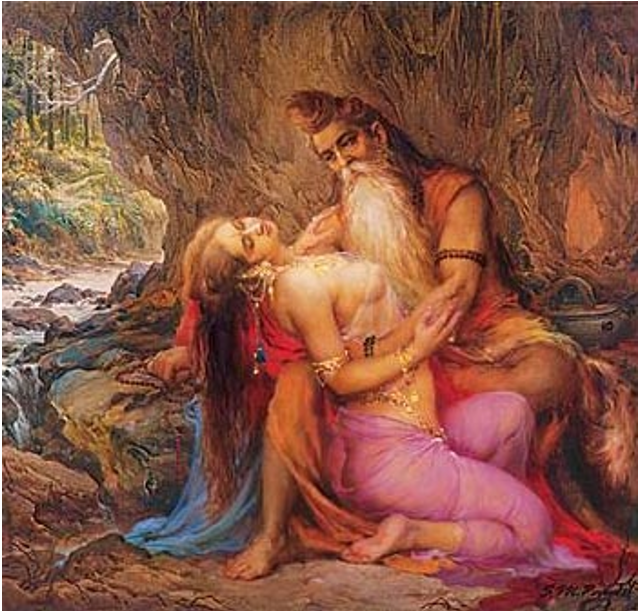
One day, when Pramadvara was playing with her friends in the forest, a venomous snake sunk it fangs into the body of the girl. As soon as she was bitten, Pramdvara fell down senseless on the ground. On hearing the news, Ruru rushed to see his beloved and was overwhelmed with grief to see the beautiful Pramadvara lying dead on the ground.
Unable to bear the sight of his dead lady love, Ruru wept loudly. He cried out loud saying if indeed he had remained true to his austerities as a Brahmin, had performed the prescribed rites, respected the elders and had selflessly given away alms, then his dear Pramadvara would have to rise from the dead.
On hearing Ruru’s lamentations, the messenger of the gods responded saying that no amount of bemoaning by Ruru could help Pramadvara, for once the mortal life of a person was over, there were no means of reviving them.
However, the messenger offered a consolation….there was one way by which Pramadvara could be brought back to life. If Ruru was ready to give up half of his life for Pramadvara, she could be brought back from the land of the dead. Hearing this, Ruru was overcome with joy. He readily agreed to give up half of his long life span for his dear, beloved Pramadvara.
At once, the permission of Yama – the lord of death was sought. Yama consented to allow Ruru to revive Pramadvara. Immediately thereafter, Pramadvara arose from the dead, lovely as ever, filling the grieving Ruru’s heart with untold joy. The lover couple was ecstatic to be back together again.
Ruru and Pramadvara were married shortly thereafter, and the couple spent many a wonderful year rejoicing in each other’s company.
Thus, Ruru stands tall among men, who are capable of as much love as a woman, and can even make the ultimate sacrifice of partaking their lives with their lady loves.
The great Indian epic, the Mahabharata, is full of riddles, puzzles and dilemmas. The epic poses several intriguing problems that make us wonder, who was right and who was wrong, who was good and who was bad…
But the one big question about the epic that baffles us no end is about Draupadi….
Why did she have five husbands?
Was Draupadi a victim of fraternal polyandry – a system where all the brothers in a family married the same woman to prevent land fragmentation?
Or was this Kunti’s idea to use Draupadi as the glue to keep her sons struck together?
Or, was poor Draupadi merely a pawn in the game fought by Pandavas and Kauravas for land?
Watch the video to know the answer to the trickiest riddle posed by the Mahabharata!
Language, as they say, marks the pinnacle of human evolution. And humour & wordplay form the crown of that pinnacle. Being home to such evolved Indian languages such as Sanskrit and Tamil, India, not surprisingly, is the wonderful land of stories centered around wit and wordplay.
This video takes you through some of these stories, highlighting a unique wordplay episode from the life of the great Sanskrit poet Kalidasa and a story of uncanny humour involving the Tamil scholar Avvaiyar and her favourite deity, Murugan. There is also a cute little story about how even the gods could not put a word to the relationship between Ayyappan and Goddess Lakshmi!

 Kulture Katha