What does the Panchanga tell us? (The Indian Astrology Series)

The word Panchanga or Panchangam, an many of you would know, refers to the Hindu calendar and is a combination of two words ‘pancha’ and ‘anga’ meaning five parts. The five parts are vara, tithi, karana, nakshatra and yoga.

Indian Astronomy & Modern Astronomy – A key difference

The key difference between modern day astronomy and ancient Indian astrology. While modern astronomy has established that the earth revolves around the sun, the Indian astrology follows a geo-centric model, where the celestial bodies in the sky are taken as moving bodies but the earth is presumed to be fixed. So, the movements of the sun, moon and other planets are studied keeping the earth as a fixed point. So, when we say the sun moves across the sky, what we mean is that the Sun is seen to be moving across the sky as viewed from the earth.

Vara

Vara refers to the week day. Following the Greeks, ancient Indian astronomers chose to adopt a 7-day week (why does the week have 7 days?), and the days of the week have been named after the Sun, the Moon and five planets including Mars, Venus, Jupiter, Mercury and Saturn. Thus, we have the ravivara, somavara, mangalvara, budhavara, guruvara, the shukravara and the shanivara.

Unlike the Gregorian calendar, where the day is counted from midnight to midnight, the day according to the Panchang is from sunrise to sunrise. However, the time of the sunrise changes slightly everyday as the relative position of the earth in its orbit vis-à-vis the sun keeps changing. As a result, the duration of the day is not always 24 hours.

And as we measure the day in hours and minutes, in Indian astrology, the duration of the day is measured in ghatikas or nadis, and vighatikas. A day comprises 60 ghatikas; each ghatika of 24 minutes duration.

You might note that it is the exact inverse of 24 hours of 60 minutes duration each that we follow today.

Tithi

The second element of the Panchanga is the tithi. While vara depends on the movement of the sun, the tithi is decided by the movement of the moon. A tithi refers to one lunar day. A lunar month from new moon to full moon is divided into two parts called paksha. The brighter half or the period of the waning moon is called the Shukla paksha and the darker half or the period of the waxing moon is called Krishna Paksha.

Each of the two pakshas has 15 thithis. The shuklapaksha starts with the first day of the waning moon called pratama or pratipada and ends with the 15th day, which is the full moon or Purnima. The Krishnapaksha starts with the first day of the waxing moon and ends on the 15th day, which is the no moon day or Amavasya.

In all, there are 30 tithis in a lunar month.

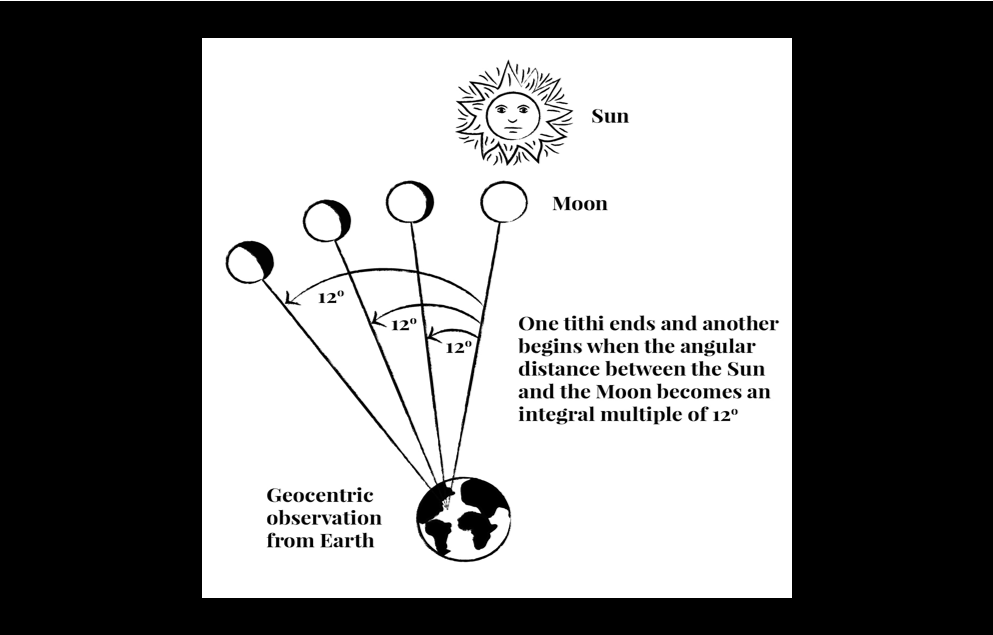
Now, the duration of a tithi is decided by the movement of the moon with respect to the sun. It is the time that the moon takes to move 12 degrees away from the sun, as seen from the earth.

But why is the distance being measured in degrees?

Here’s why. You may remember from the basic astronomy we learnt at school that the celestial bodies in our solar system move in a fixed but elliptical orbit. And we on earth see these bodies move in an arc across the sky above us.  So the only way distances can be measured on an elliptical orbit is by measuring it in angles or degrees.

As with a solar day or dina, the duration of the tithi also changes. This is because the sun and the moon are travelling at varying speeds and the time taken by them to be separated by 12 degrees keeps changing.   So, a tithi can last anywhere between 19 and 26 hours. And you can end up having more than one tithi, or an incomplete tithi in a 24-hour day.
Karana

The third aspect of the Panchanga is the Karana. A Karana is half a tithi. In other words, it is the time taken for the moon to move 6 degrees away from the sun. In all there are 11 Karanas of which 6 are considered benefic and the remaining 5 are malefic.

Both Tithis and Karanas are vested with good and bad attributes. So some tithis and Karanas are considered auspicious while some others are considered inauspicious.

Yoga

Yoga is another division of time in the panchanga. The word yoga as you’d all know means union or alignment. The yoga mentioned in the Panchanga refers to the interactions between the sun and the moon, the two key celestial bodies whose movements are tracked in our calendars.

Mathematically speaking, the yoga of the day is obtained by adding together the positions of the sun and the moon as seen from the earth, in angles or degrees. The sum obtained is then divided into 27 parts, each of which is a yoga. Each of these 27 yogas is given an attribute, some good and some bad. The yoga prevailing at sunrise is taken to be the yoga of the day.

Yoga is important from the point of view of casting a birth chart or a kundali and also for fixing the appropriate time to carry out specific activities. The yoga in which a person is born is believed to decide his or her nature and also if she is likely to be lucky, wealthy and so on. As mentioned earlier, Yoga also helps fix the muhurta or the right time to carry out a specific action.

Nakshatra

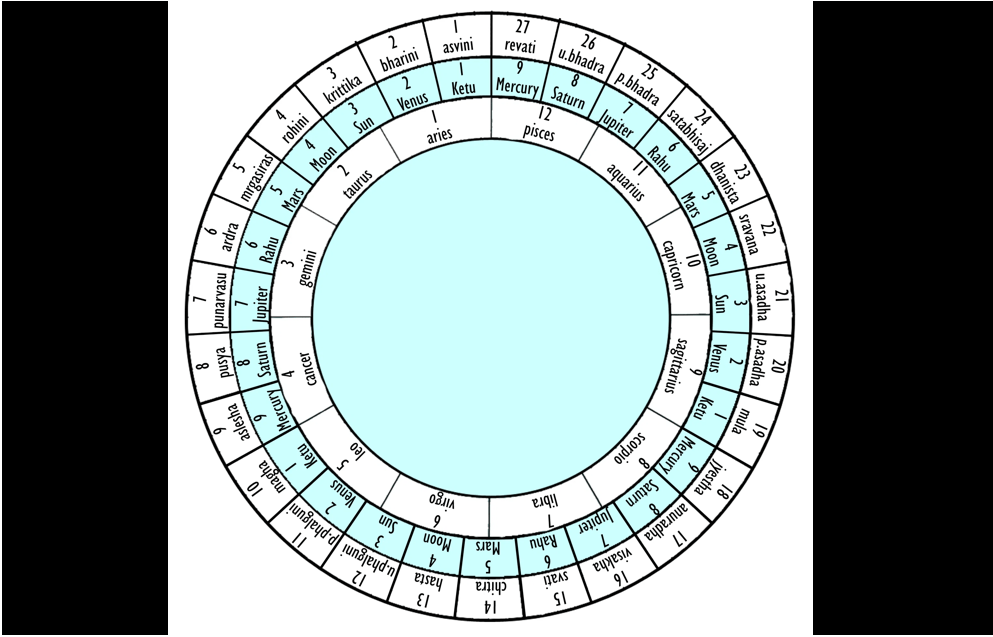
Nakshatras are a very ancient Vedic concept where the moon’s path in the sky is divided into segments of constellations. We all know the moon rotates around the earth. Its movement in the sky is traced, and depending on its position, its orbit is divided into 27 arcs into which fall various constellations. In other words, the nakshatra system is used to plot the moon with respect to the other stars in the sky (why are there 27 nakshatras in astrology?).

Although, nakshatra is commonly understood as a star, in astrology, it actually refers to a constellation of stars.  The particular constellation where the moon is found is identified by a prominent star in that constellation. And so we have the Ashvini, Chaitra, Revathi, Jyeshta, Vishaka nakshatras etc.

In Indian mythology, the moon is believed to chase the nakshatras who are imagined as his wives. To the ancient Indian astronomers, however, these nakshatras were a kind of unchanging celestial markers. These markers enabled the astronomers to keep track of the moon’s movement across the sky.

As with yoga, the nakshatras are also believed to possess certain specific attributes. So a person born in a particular nakshatra is believed to possess certain specific qualities.
Lunar tilt of our calendars

Of the above five limbs of the panchanga, nakshatra, tithi and karana are based on the movement of the moon while only the vara is based on the movement of the sun. Yoga, of course, takes into consideration the orbits of both the sun and the moon. So we find that 4 out of the 5 elements of the panchanga are based on the moon’s movement, making our calendars a largely lunar calendar.

Is Astrology a pseudo-science? (The Indian Astrology Series)

Today, when we think astrology or any other type of fortune telling, many of us tend to rubbish it off as a pseudo-science that makes a false claim to do the impossible by claiming to predict the future.

But is fortune telling really a pseudo-science that tries to exploit human vulnerability and play on our fear psychosis? Is it all about doomsday prophecies, or making rosy promises?

While the answers to the questions may not be simple or straight, it’d definitely help to know that fortune-telling evolved for a different purpose other than what we know it for, today.

When I say fortune-telling, I’m referring to astrology here. Of course, there are many other methods used to foretell the future, which we shall look at, maybe in one of the following videos. Right now, we’ll stick to astrology.

Let’s now go back a few thousand years to ancient India. The ancient man, who was still trying to figure out the laws of the complex world he lived in, probably found comfort in certain repetitive happenings and interesting patterns that he observed up in the sky.

Looking up at the sky, he noted that the celestial bodies followed a certain fixed path. For example, the sun always rose in a particular direction and set in the opposite direction. The phases of the moon followed a similar repetitive pattern in its journey across the sky from no moon to new moon.

And he observed that nature also followed a set pattern where the sun blazed away in a particular season, the rains fell in another, and the flowers bloomed at a particular time and so on. He soon realised that these patterns were cyclical and were related to the back and forth movement of the sun across the sky, as seen from the earth. He called it the natural cosmic order, Rta.

Similarly, he observed that the phases of the moon followed a 30-day cycle from new moon to new moon. So, he referred to the moon as Masakrit or the maker of months. The movement of the moon and the sun thus enabled Vedic man to arrive at the concept of months and year and create a calendar for time-keeping.

As I have already mentioned in my previous videos, the calendar system followed initially was primarily lunar, based on the movement of the moon across the star constellations called nakshatras. This may have been because the moon’s journey across the sky is far more noticeable in the night than the sun’s path during the day.  So, it’s only around the few centuries before the start of the Christian era that the rashi system based on the movement of the Sun was adopted and our calendars became luni-solar.

The initial development of astrology was based entirely on observation of the luminary bodies which explains why the subject is called Jyotisha, which is derived from the word Jyoti that means light in Sanskrit. The most ancient knowledge on this subject is found in the Vedas, where it’s included as an auxillary subject and is referred to as Vedanga.

But from where did man’s need for astrology arise? Why did he find the need to make predictions?

The need for astrology among Vedic Indians rose from their need to perform sacrificial rituals or Yagnas at appropriate and auspicious times. Yagnas or sacrifices, as you’d know, was Vedic man’s way of communicating with the gods in heavens, to seek their blessings. And these sacrifices were effective only if they were carried out strictly as per specifications laid down in the Vedic texts. 

So the ancient field of Jyotisha only dealt with time-keeping in order to ascertain the auspicious day and time as required for the Vedic rituals. In fact, a Vedic ritual called Gavaamayana was specifically dedicated to observing the daily movement of the Sun during the day and the disappearance of the moon in the night.

So, making prophesies about the future, as done today were not part of the early Jyotisha.

However, over time, man realised that what happened in the sky had a bearing on the life on earth too. For example, a particular hot summer caused by a harsh Sun or the failure of rains created distress for livings beings on the earth. An understanding of this inter-linkage and the cyclicality that he observed in the cosmic events led man to predict happenings on the earth based on certain happenings in the sky.

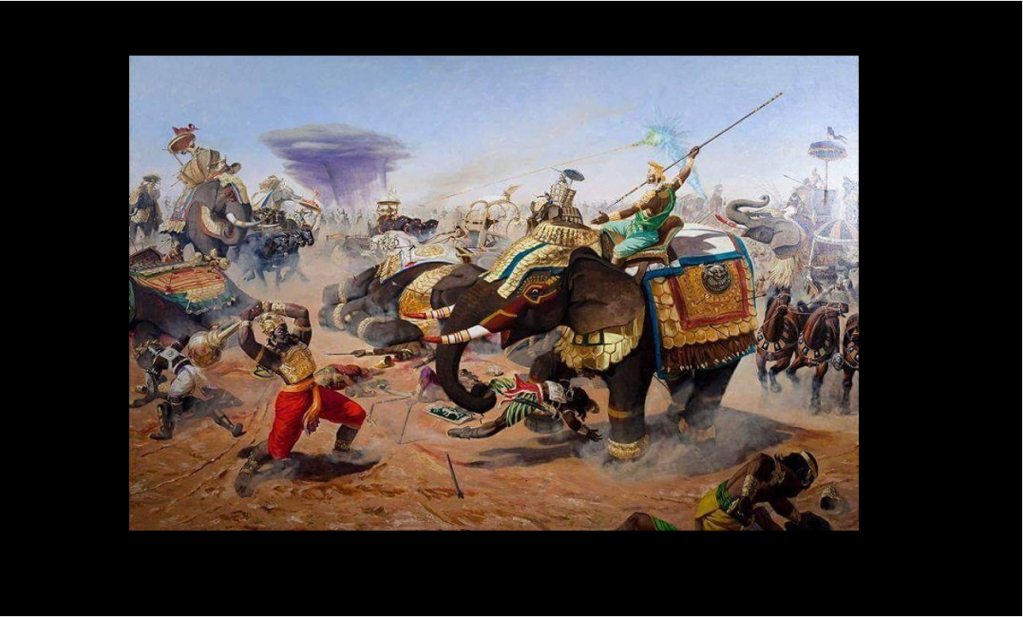
And this understanding led to the development of predictive astrology although the prophesies were made for the community at large and not for individuals. Our epics, Ramayana and Mahabharata, are replete with references to astronomical references and in the context of the Mahabharata war, we find a detailed account of the planetary and stellar configurations that fortell an impending war of epic proportions.

Indian astrology is firmly rooted in the basic philosophy or world view of ancient Indians.

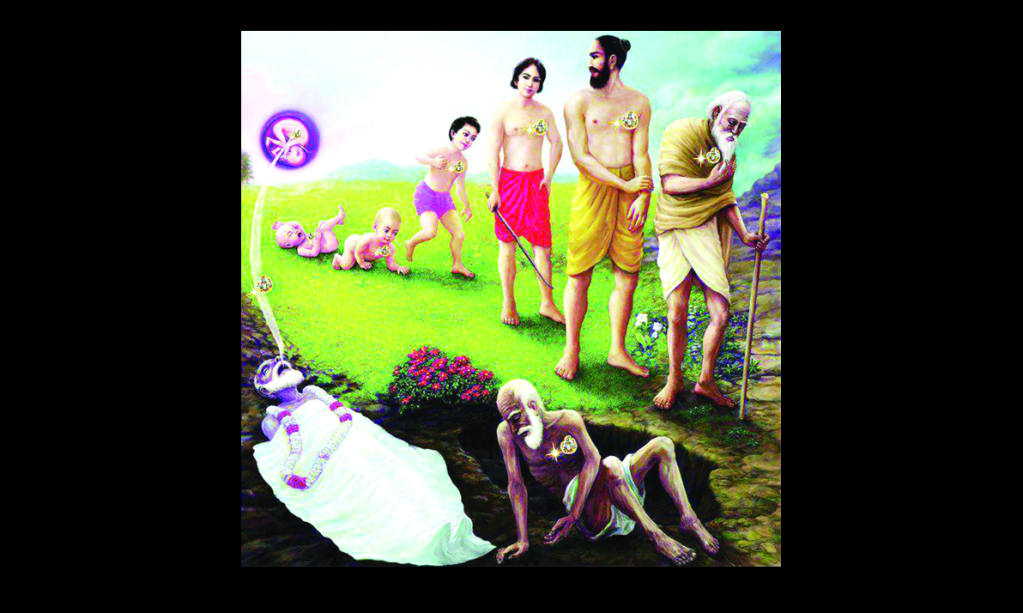
For Indians, cosmic order is cyclical. The time from creation to preservation to eventual destruction follows a cyclical order. This cyclicality forms the basis for the idea of rebirth. A man is born, he lives and then he dies, only to be born again. In such a worldview, events tend to repeat. These repetitive events thus become predictable.

But again, as people lived in small and closed groups and shared  a combined fortune, prophesies were made for societies and communities as a whole. It’s only in more recent years, that the concept of casting an individual’s horoscopes and predicting his or her fortune came into practice. This again is based on yet another philosophical idea integral to Indian culture.

In Indic religions that include Hinduism, Buddhism, Jainism and Sikhism, man’s life in this world is believed to follow a pattern that is determined by his actions, what is called Karma. So his own actions decide what happens to him either in this birth or the next, thus enabling predictions based on his current conduct or behaviour. The development of this idea led to the evolution of fortune-telling for individuals.

And there is one compelling logic that binds all these ideas, and that idea is called Brahman. Ancient Indians perceived themselves as an integral part of the larger Universe. The ancient man saw himself as the microcosm that was part of the larger macrocosm.

This idea of underlying oneness in the Universe was defined as Brahman. Based on this understanding, what happened in the distant heavens, such as the changes in the movements of distant planets was believed to have a bearing on life on earth.

To use a loose analogy, this idea is a bit like the idea of modern-day chaos theory, where a butterfly flapping its wings in Peking, China is believed to impact the weather systems in distant New York. This inter-connectedness of the Universe is deep and has not yet been fully understood by mankind.

Having said that, we must remember, ancient Vedic seers were among the first men to perceive this oneness and harness this knowledge to bring a little more order to our lives!